Ordesa y Monte Perdido Hiking Guide
A complete guide to hiking Ordesa y Monte Perdido, with detailed routes, standout viewpoints, practical advice and the ideal times of year to experience the park.
.jpg&w=1920&q=75)
Quick links
Don't want to read all this?
We've planned 2,000+ hiking trips. Send your dates, fitness and group size — we'll map the route and book every night.



What Is Ordesa y Monte Perdido?
Ordesa y Monte Perdido National Park sits in the central Pyrenees of northern Spain, right on the border with France. Known for its towering limestone cliffs, deep glacial valleys and dramatic high-mountain scenery, it’s widely considered one of Europe’s top hiking destinations.
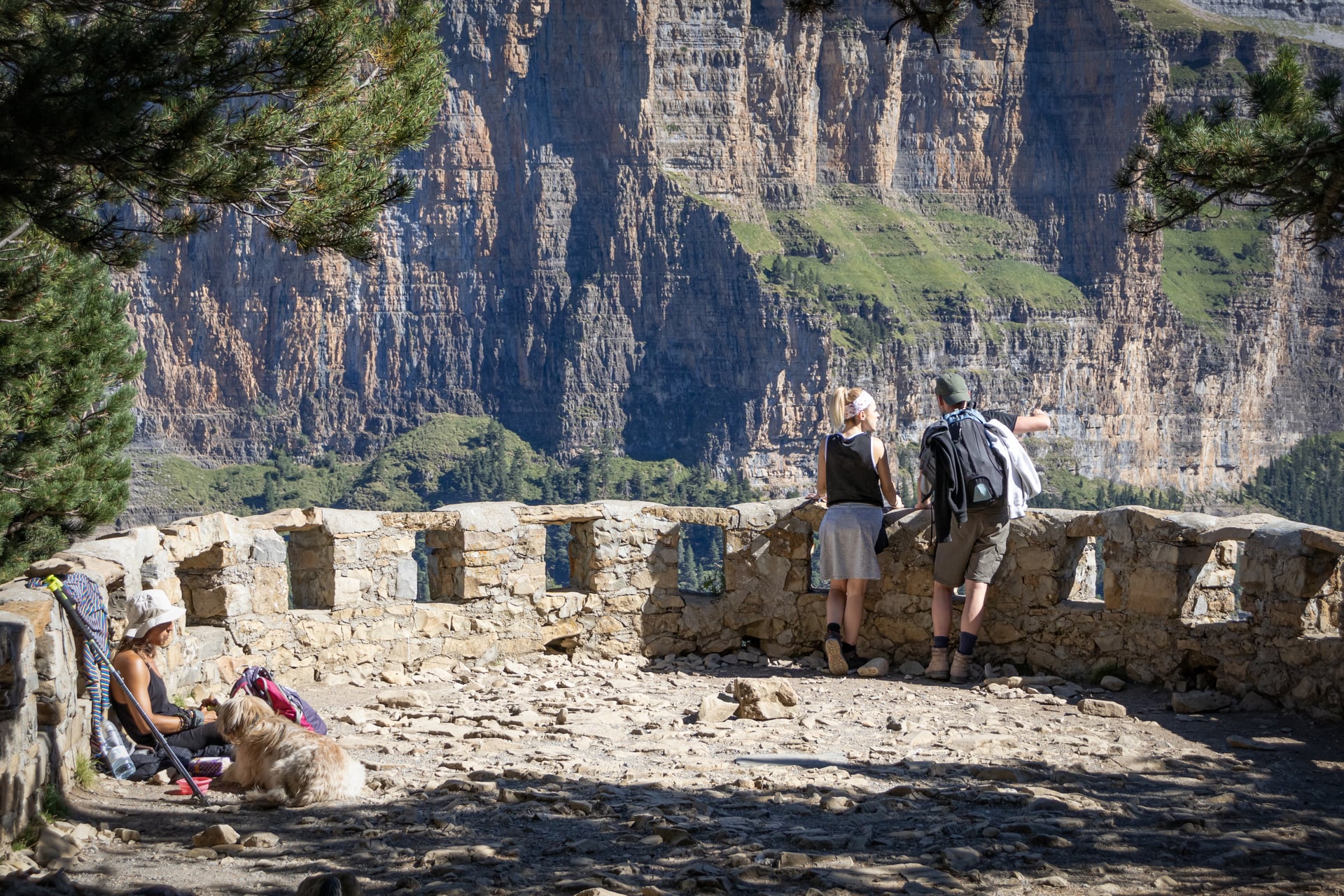
The landscape packs an incredible variety into a compact area: vast amphitheatre-like cirques, narrow canyons, powerful waterfalls and balcony trails that offer some of the most impressive viewpoints anywhere in the Pyrenees.
What makes Ordesa especially appealing for hikers is how accessible its dramatic terrain is. You don’t need long approach days to see its best features, big scenery begins right from the valley floors. With four distinct valleys and more than 100 km of marked trails, the park offers everything from relaxed family-friendly routes to full-day alpine challenges, making it suitable for first-time visitors and experienced mountain hikers alike.
Map of Ordesa y Monte Perdido National Park
About Ordesa y Monte Perdido National Park
Ordesa y Monte Perdido is Spain’s oldest national park after Picos de Europa, founded in 1918 to protect one of Europe’s most spectacular high-mountain limestone massifs. It spans more than 15,600 hectares across four valleys—Ordesa, Añisclo, Escuaín and Pineta—each offering its own terrain, atmosphere and style of hiking.
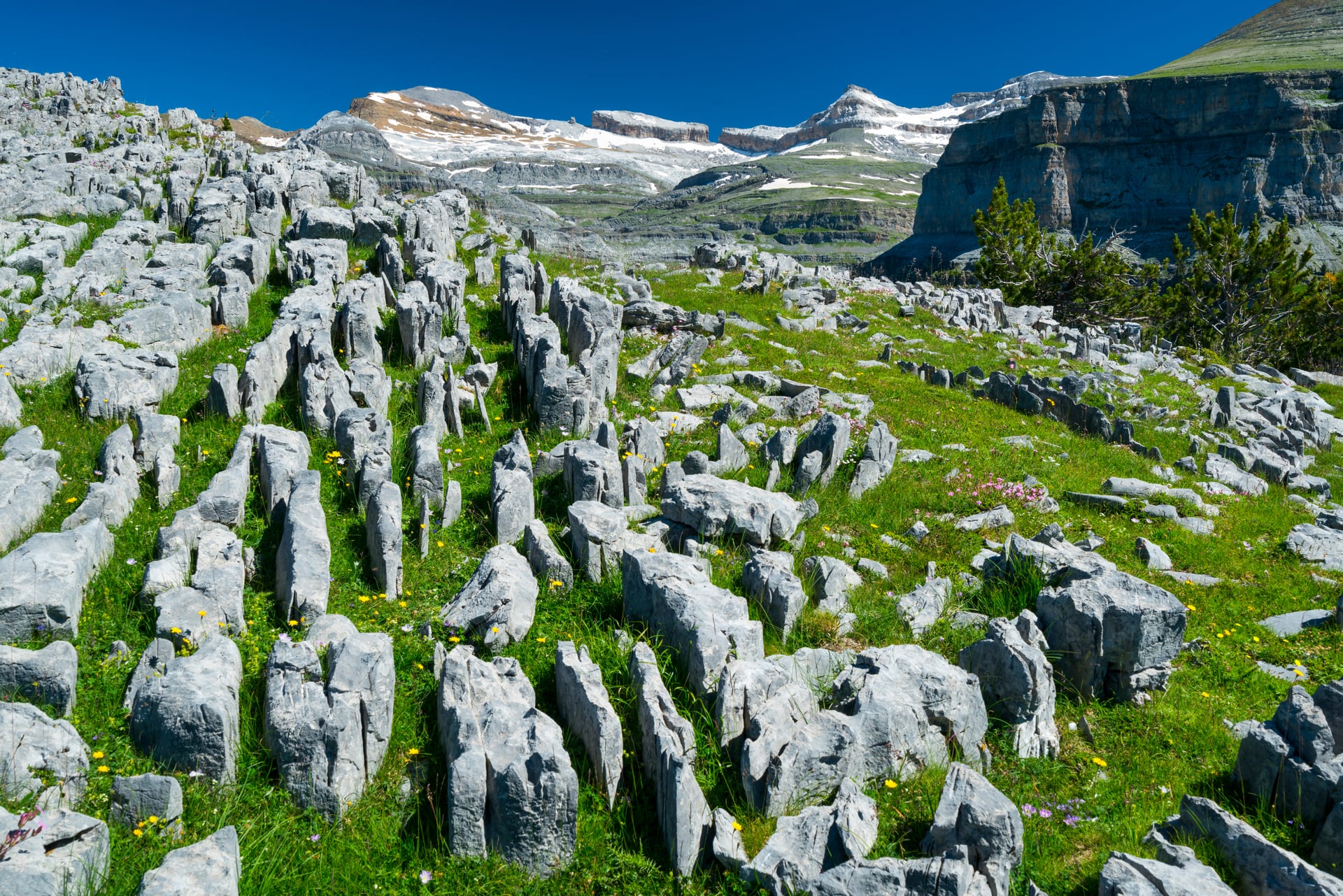
Key facts at a glance:
📍 Location: Central Pyrenees, Aragón (Huesca province)
🏛️ Established: 1918 (UNESCO World Heritage since 1997)
⛰️ Highest peak: Monte Perdido, 3,355 m (highest limestone mountain in Europe)
🏔️ Valleys: Ordesa, Añisclo, Escuaín, Pineta
🌄 Landscape: Glacial valleys, limestone cliffs, canyons, cirques and waterfalls
🥾 Trails: 100+ km of marked paths, from easy walks to technical alpine hikes
🦅 Wildlife: Bearded vultures, chamois, marmots and high-mountain flora
What Defines Ordesa as a Hiking Destination
Unlike the forested French valleys or the remote stages of the Pyrenean High Route, Ordesa packs a remarkable amount of dramatic terrain into a single national park. Massive limestone walls rise vertically from the valley floor, natural amphitheatres shape the landscape, and waterfalls pour down cliffs in every season. Well-marked trails lead you from gentle riverside walks to exposed balcony paths and serious summit routes.
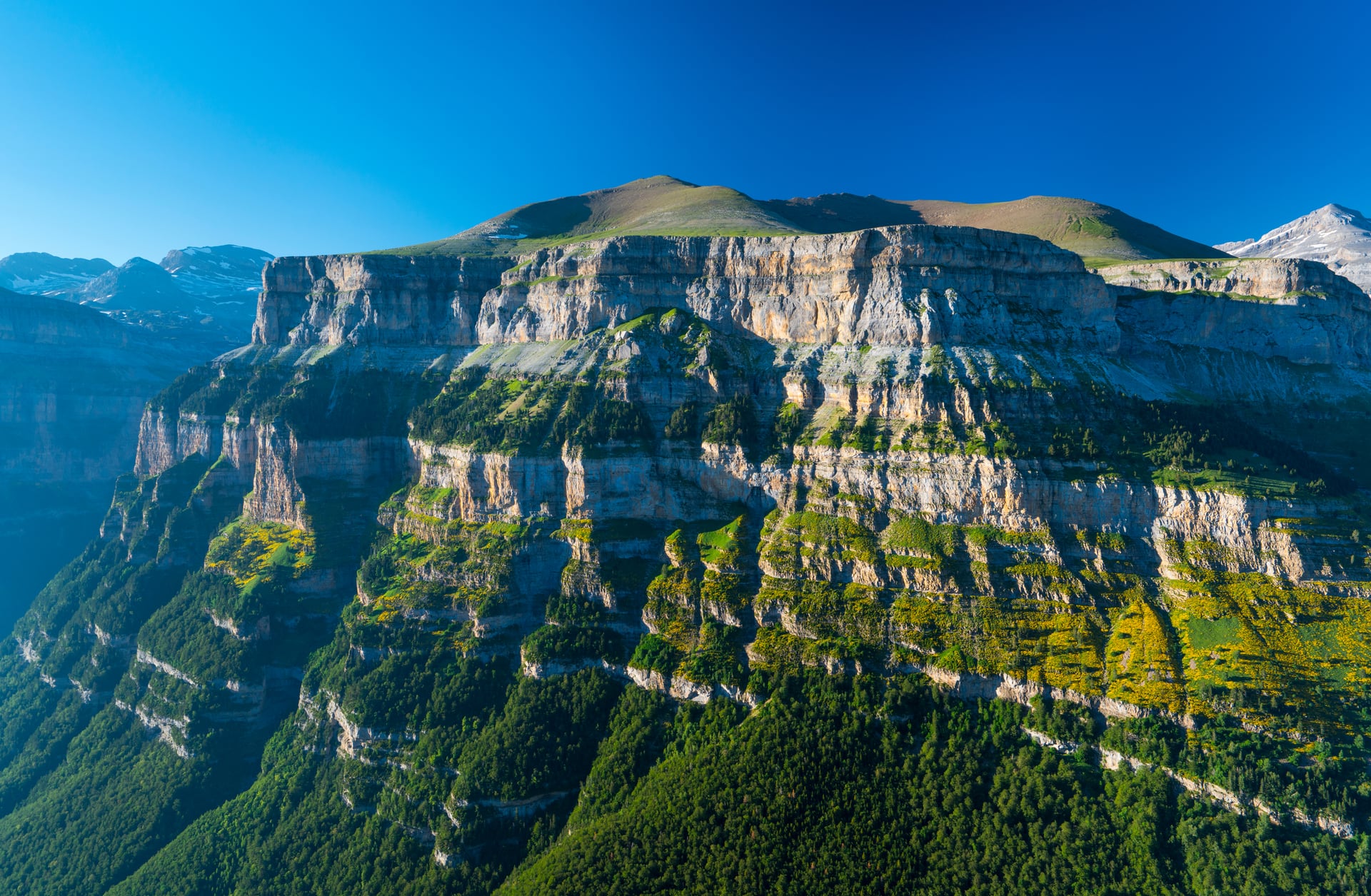
Whether you explore for a weekend or spend a full week hiking all four valleys, Ordesa delivers unforgettable mountain scenery that stays with you long after the trip ends.
Ordesa vs Other Pyrenean Hiking Destinations
If you are planning a hiking trip to the Pyrenees, Ordesa y Monte Perdido is one of several outstanding options. Each area offers a different experience depending on your preference for scenery, difficulty and infrastructure.
1. Ordesa y Monte Perdido (Spanish Central Pyrenees)
Ordesa is defined by its concentrated drama. Massive limestone walls, deep glacial valleys and a dense network of trails make it one of the most visually striking parks in Europe. The scenery feels alpine and powerful, but the park remains accessible with good infrastructure, marked trails and nearby villages.
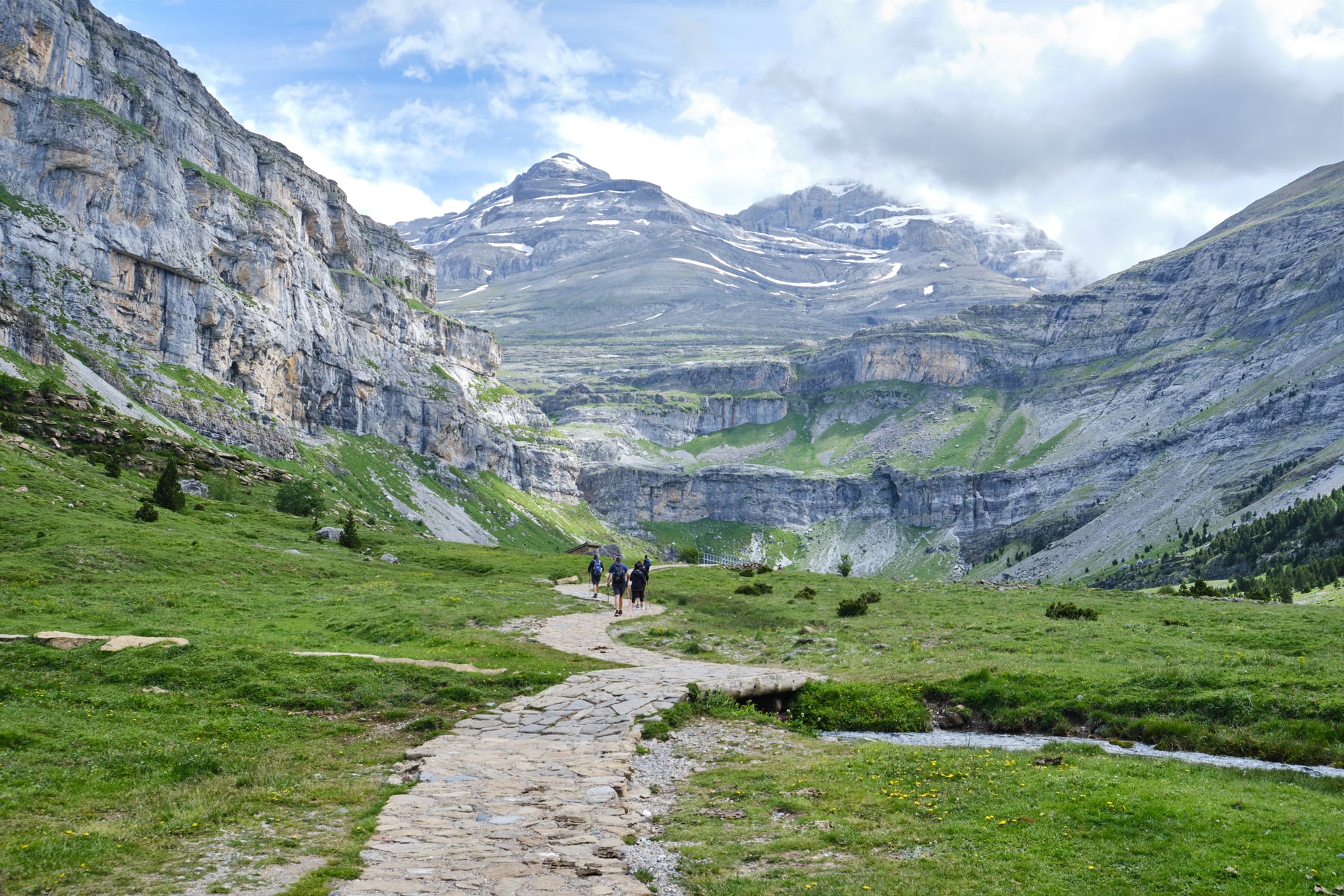
Ordesa is ideal for hikers who want a short, intense mountain experience without committing to a multi-week trek. Even a weekend visit allows you to experience world-class landscapes.
2. GR10 (French Side of the Pyrenees)
The GR10 is a long-distance trail that crosses the entire French side of the Pyrenees from the Atlantic to the Mediterranean. It stays at moderate elevations and dips regularly into valleys, providing frequent access to villages, gîtes and refuges. The GR10 is a 40–55 day commitment and offers a more gradual, varied journey through the Pyrenees.
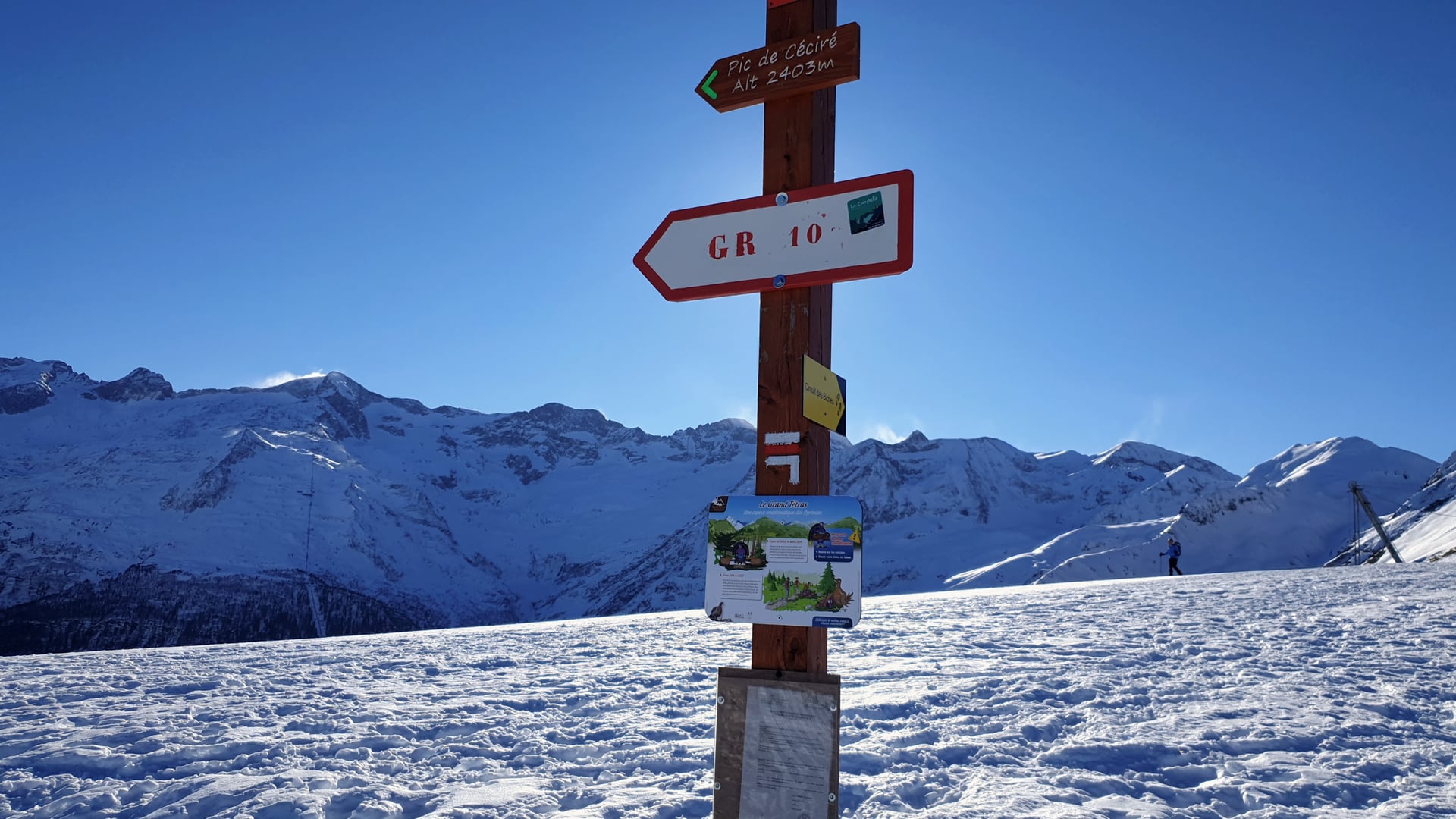
The GR10 is perfect for hikers seeking a long, immersive trek with strong cultural and landscape variety. It is less dramatic than Ordesa on any single day but covers far more ground.
3. GR11 (Spanish Side of the Pyrenees)
The GR11 mirrors the GR10 but follows the southern, Spanish slopes of the range. It tends to stay higher and drier than the French route, with more sunshine and fewer villages. The GR11 passes through Ordesa, making it possible to experience the park as part of a much longer traverse.
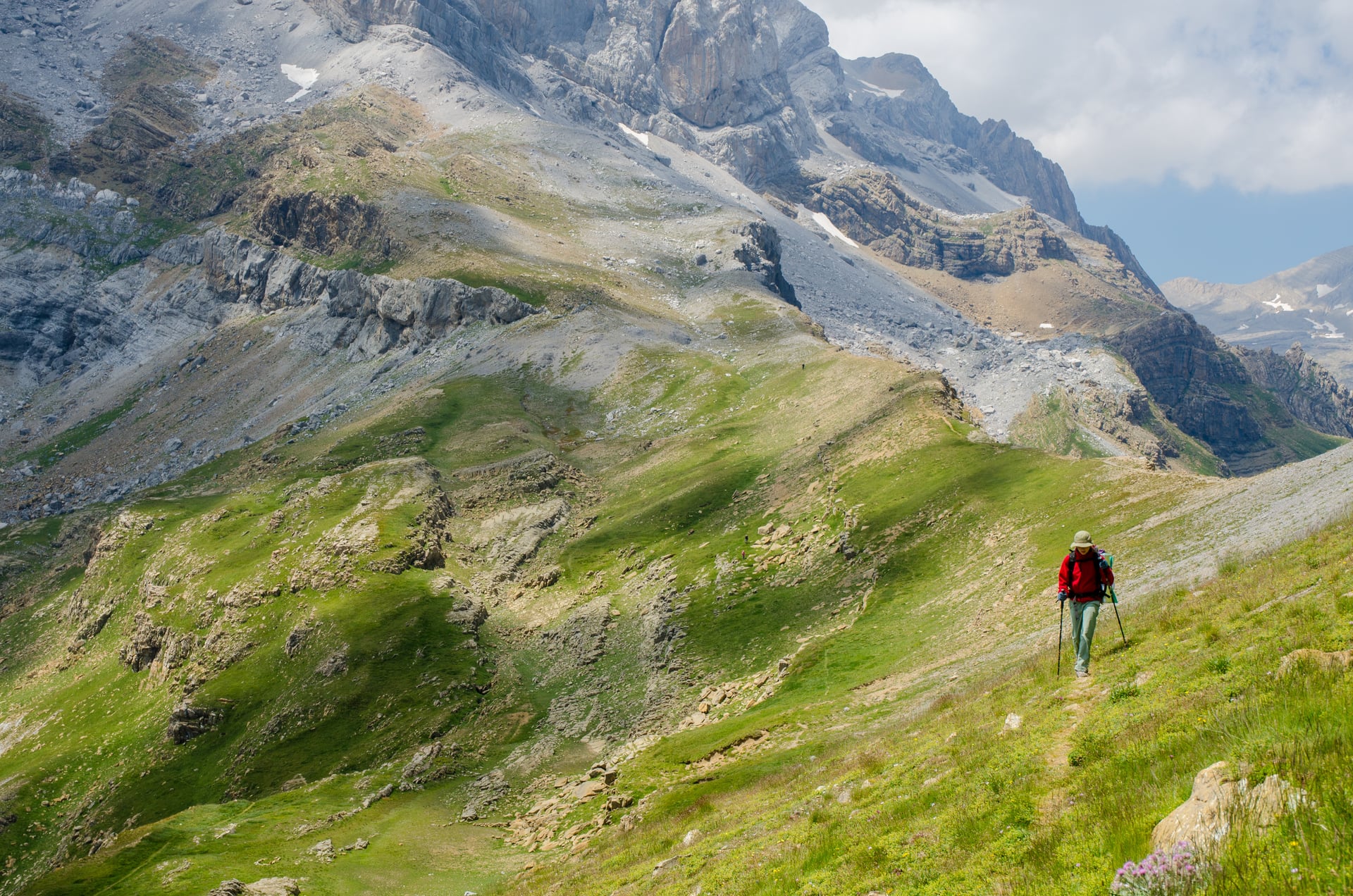
Hikers who prefer warmer weather, longer stages and more remote terrain often choose the GR11 over the GR10.
4. Pyrenean High Route (HRP)
The HRP is the most demanding of all Pyrenean routes. It follows the ridgeline along the Franco-Spanish border and stays at high altitude for most of its length, crossing numerous passes above 2,500 metres. The route occasionally requires scrambling and basic mountaineering skills.
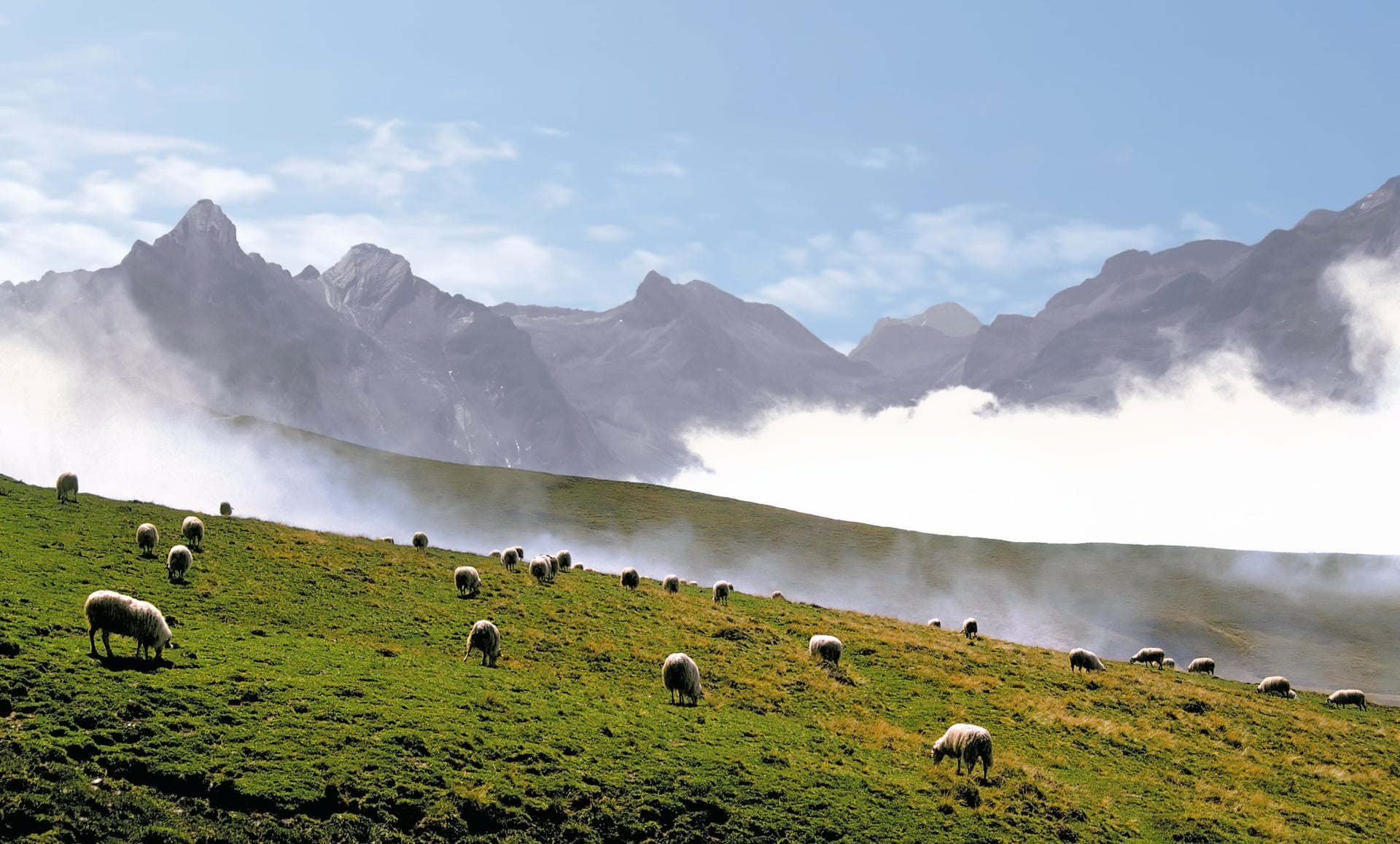
The HRP offers the most dramatic alpine scenery but is only suitable for experienced mountain trekkers with strong navigation skills and technical confidence.
Quick Comparison
Destination | Duration | Elevation | Difficulty | Best For |
Ordesa y Monte Perdido | 2–7 days | Moderate to high | Moderate to very hard | Concentrated alpine scenery in a short time |
GR10 | 40–55 days | Moderate (rarely above 2,500m) | Physically demanding but non-technical | Long trek with villages and cultural immersion |
GR11 | 40–50 days | Moderate to high | Similar to GR10, slightly more remote | Sunny, drier conditions on the Spanish side |
HRP | 40–50 days | High (often above 2,500m) | Very hard, some scrambling required | Serious alpine challenge with technical demands |
If you want a short but powerful mountain experience with dramatic scenery and excellent infrastructure, Ordesa is the natural choice. If you prefer a long-distance trek with varied landscapes and cultural connections, consider the GR10 or GR11. And if you are after the most challenging and spectacular high route, the HRP is unmatched.
When to Visit Ordesa y Monte Perdido
The main hiking season runs from late June to late September, when most snow has melted above 2,000 metres and the trails are fully accessible. Valley temperatures during this period typically range between 18°C and 26°C, while higher elevations sit closer to 10–15°C. The park's position in the southern Pyrenees means it enjoys more sunshine than the French side, though afternoon storms remain common throughout summer.
Below is a clear breakdown of what each season offers so you can choose the best time for your trip.
Late June - July: Early season, snow finally clears on high routes; cool mornings and excellent visibility
August: Peak season, warm, busy, and storm-prone in the afternoons
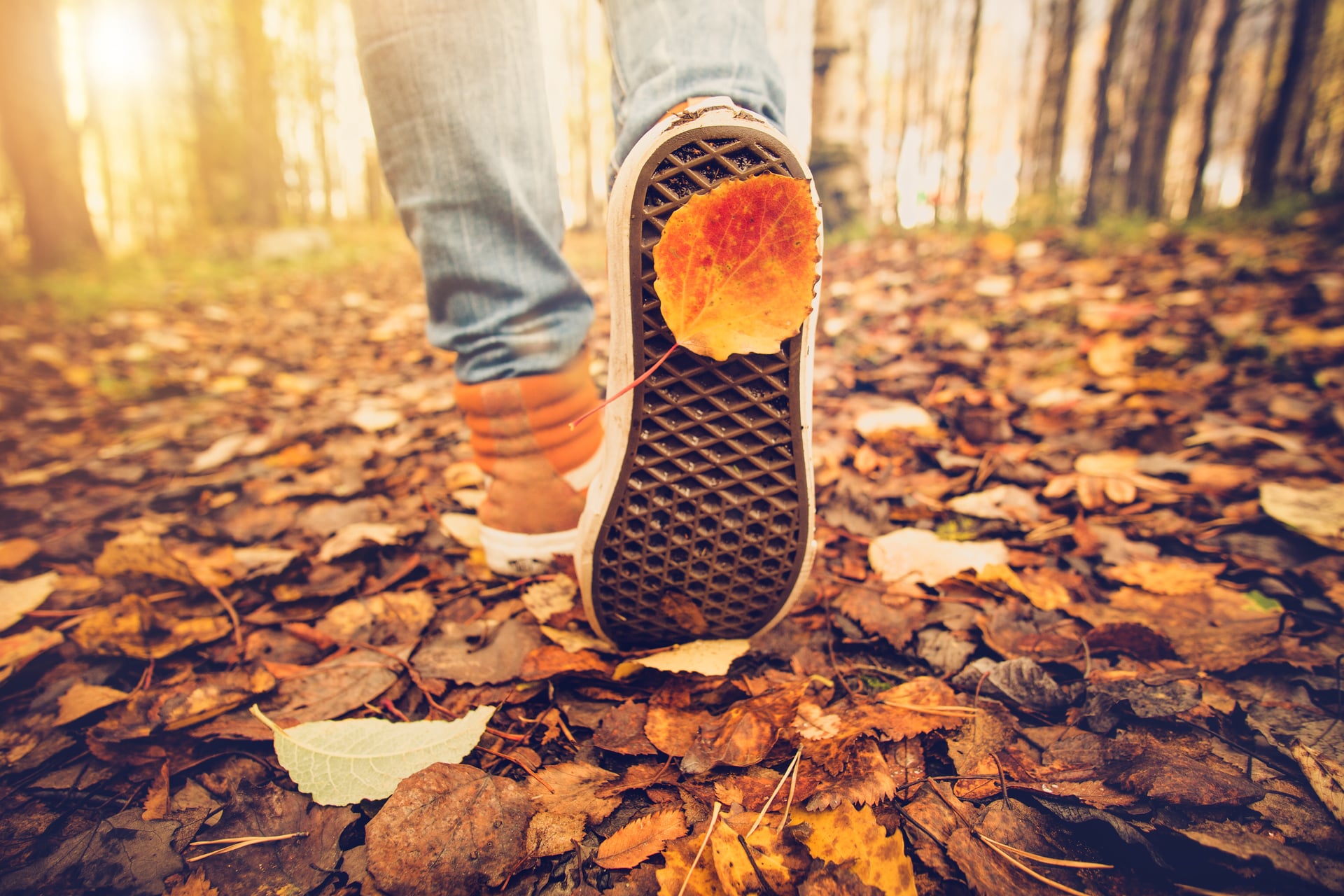
September - Mid October: Ideal window, stable weather, mild temperatures, and spectacular autumn colour
Mid October - May: Winter conditions, snow, ice, and mountaineering terrain above the valleys
Spring (April–June)
Spring arrives late in Ordesa due to altitude. April and most of May still hold snow above 1,800–2,000 m, but valley trails reopen early and conditions improve quickly toward June. By late June, most classic routes are accessible.
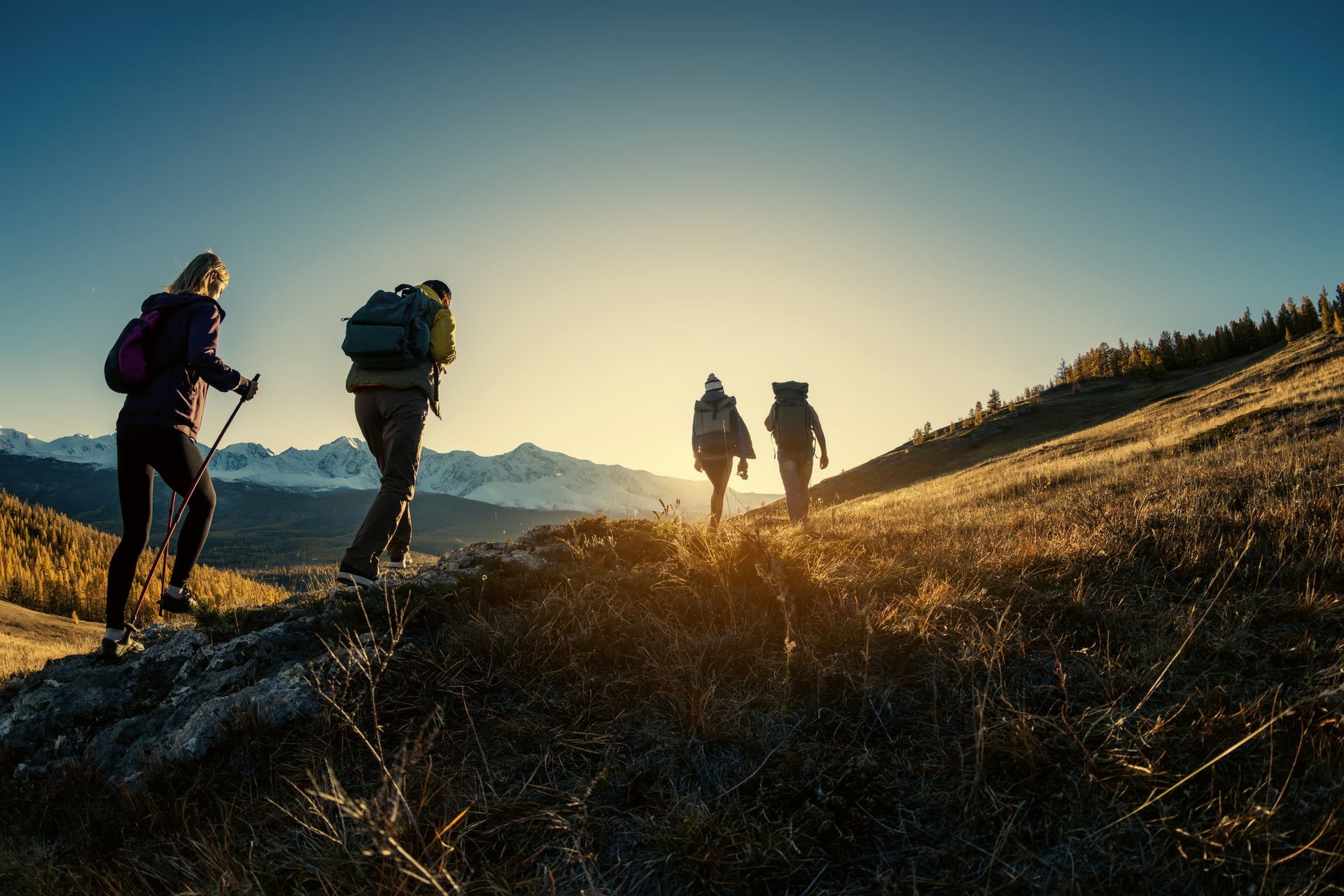
Temperatures: Valleys typically sit between 10–20°C, while high routes remain cooler at 5–12°C, especially early in the season.
Best for: Early-season hikers who enjoy cooler weather, quieter trails, and strong river flow with impressive waterfalls.
Good to know:
High routes may hold snow until mid–late June
Early June offers excellent conditions and low crowds
Rivers and waterfalls are at their strongest
Summer (July–August)
Summer is the busiest season in Ordesa. Trails are fully open, mornings are clear, and days are long — but afternoon storms are common. An early start makes a huge difference in both conditions and crowd levels.
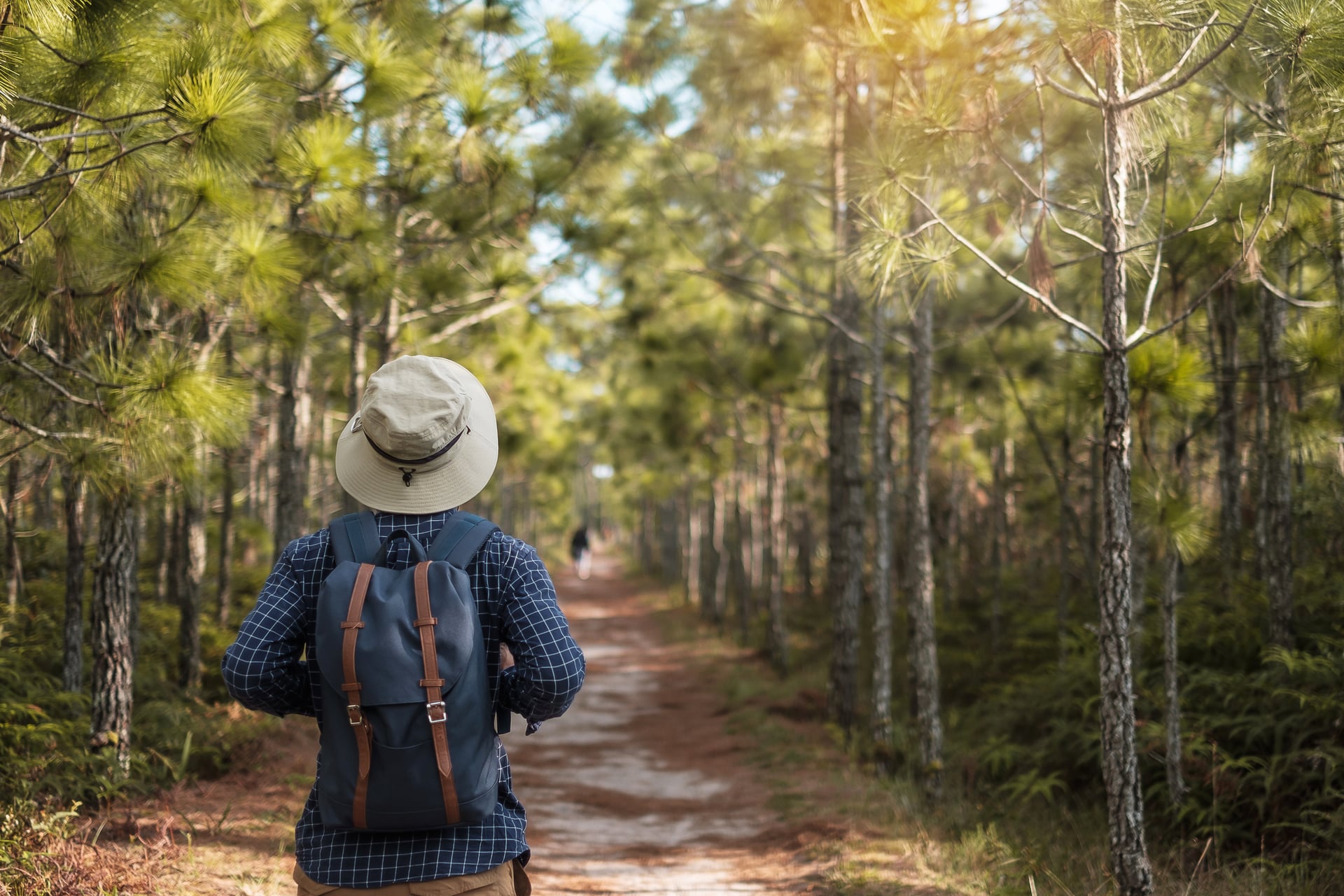
Temperatures: Valley temperatures range from 18–28°C, with high routes generally between 10–18°C depending on exposure.
Best for: Big day hikes, high viewpoints, classic balcony trails, and families sticking to the easier valley routes.
Good to know:
Afternoon thunderstorms are frequent — early starts are essential
Ordesa Valley is extremely busy in August
Shuttle buses are mandatory for the Ordesa Valley in peak season
Autumn (September–Mid October)
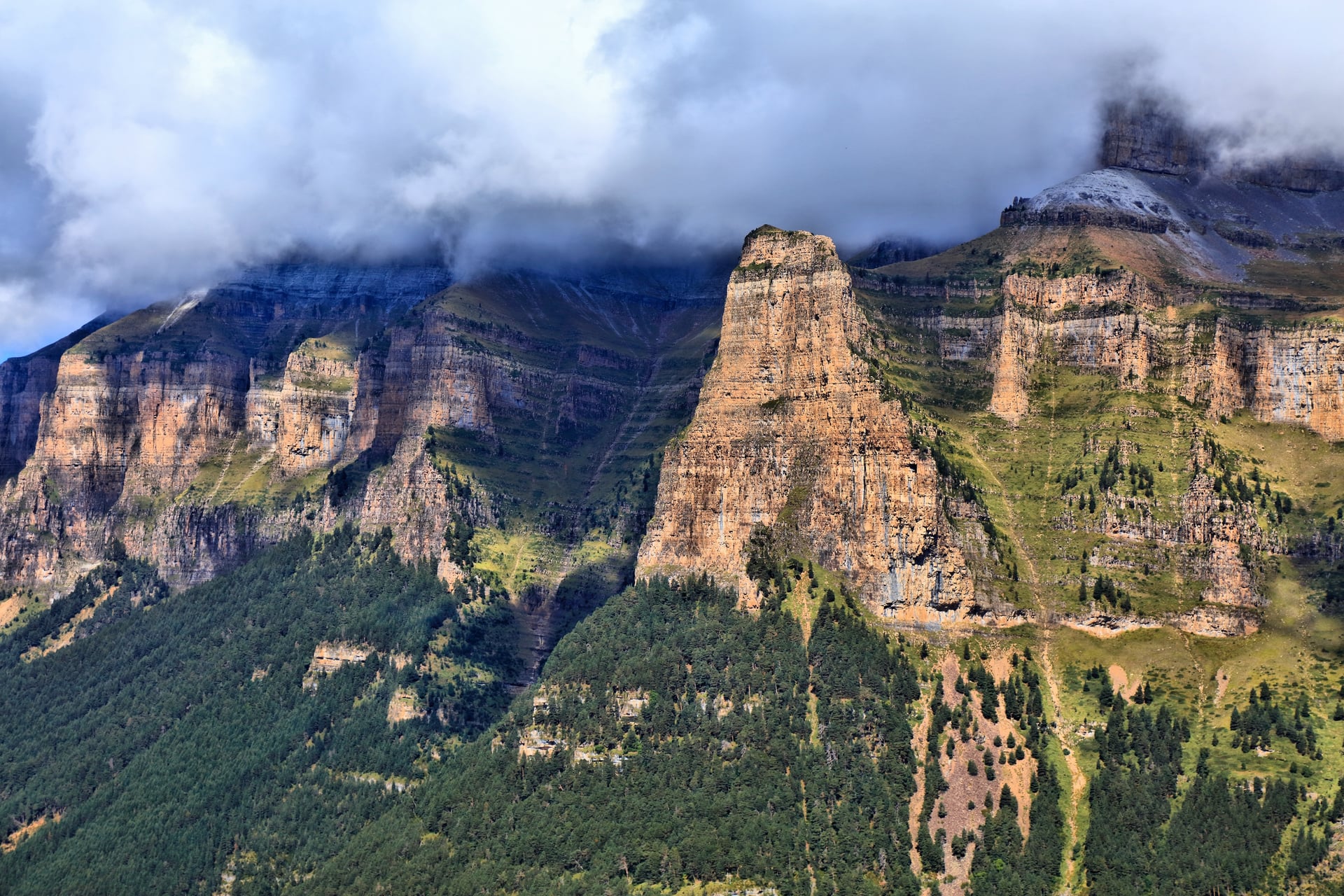
Autumn offers the best overall mix of stable weather, mild temperatures, and quiet trails. It’s also the most photogenic time of year, with beech forests turning gold and orange by early to mid-October.
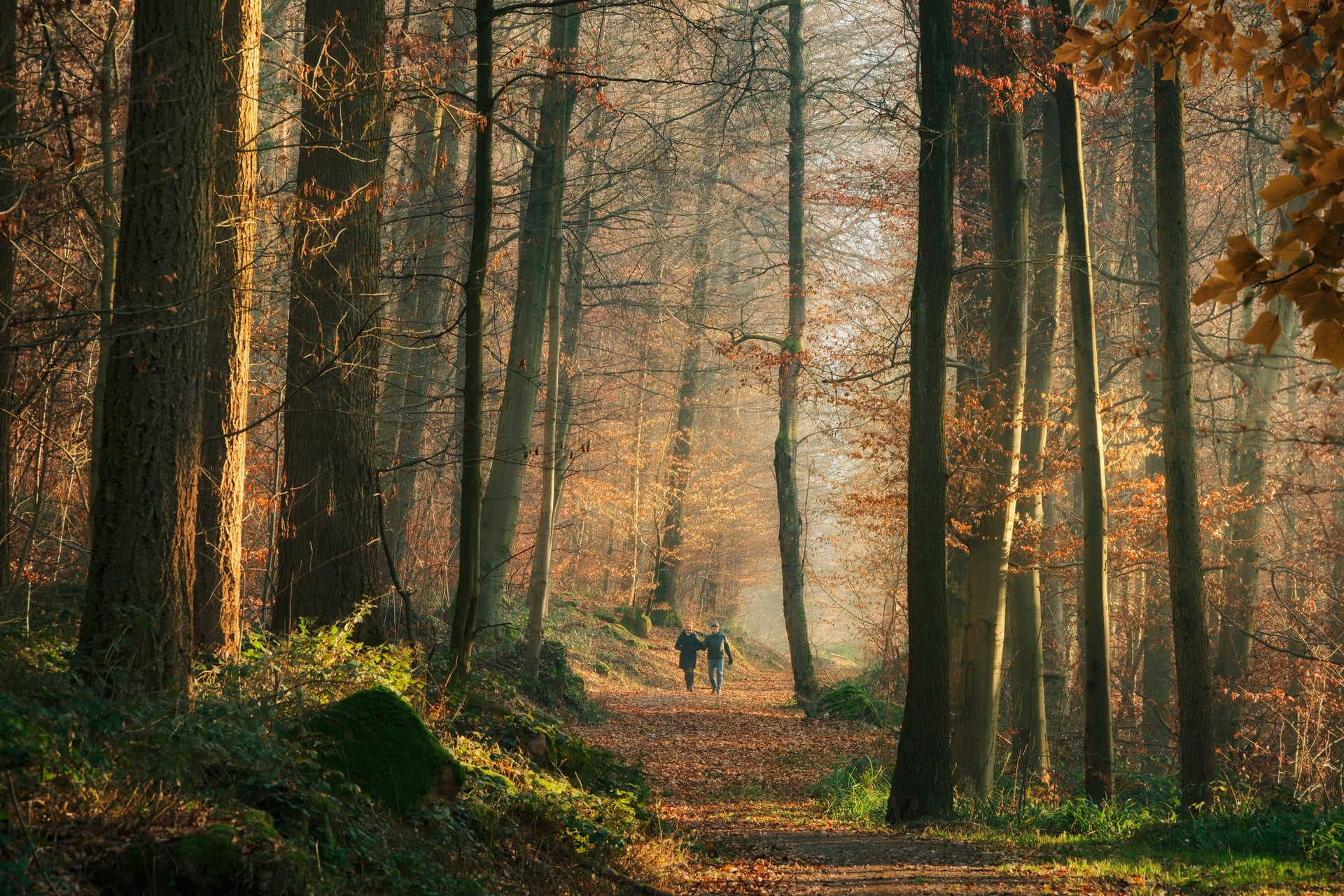
Temperatures: Valleys reach 12–22°C, while high routes typically sit between 6–14°C, giving crisp, clear hiking conditions.
Best for: Long-distance routes, high-altitude days, photographers, and hikers looking for quieter trails with excellent visibility.
Why go in autumn:
Stable weather and minimal storms
Brilliant autumn colours
Clear air and long viewpoints
Far fewer visitors than summer
Winter (Mid October–May)
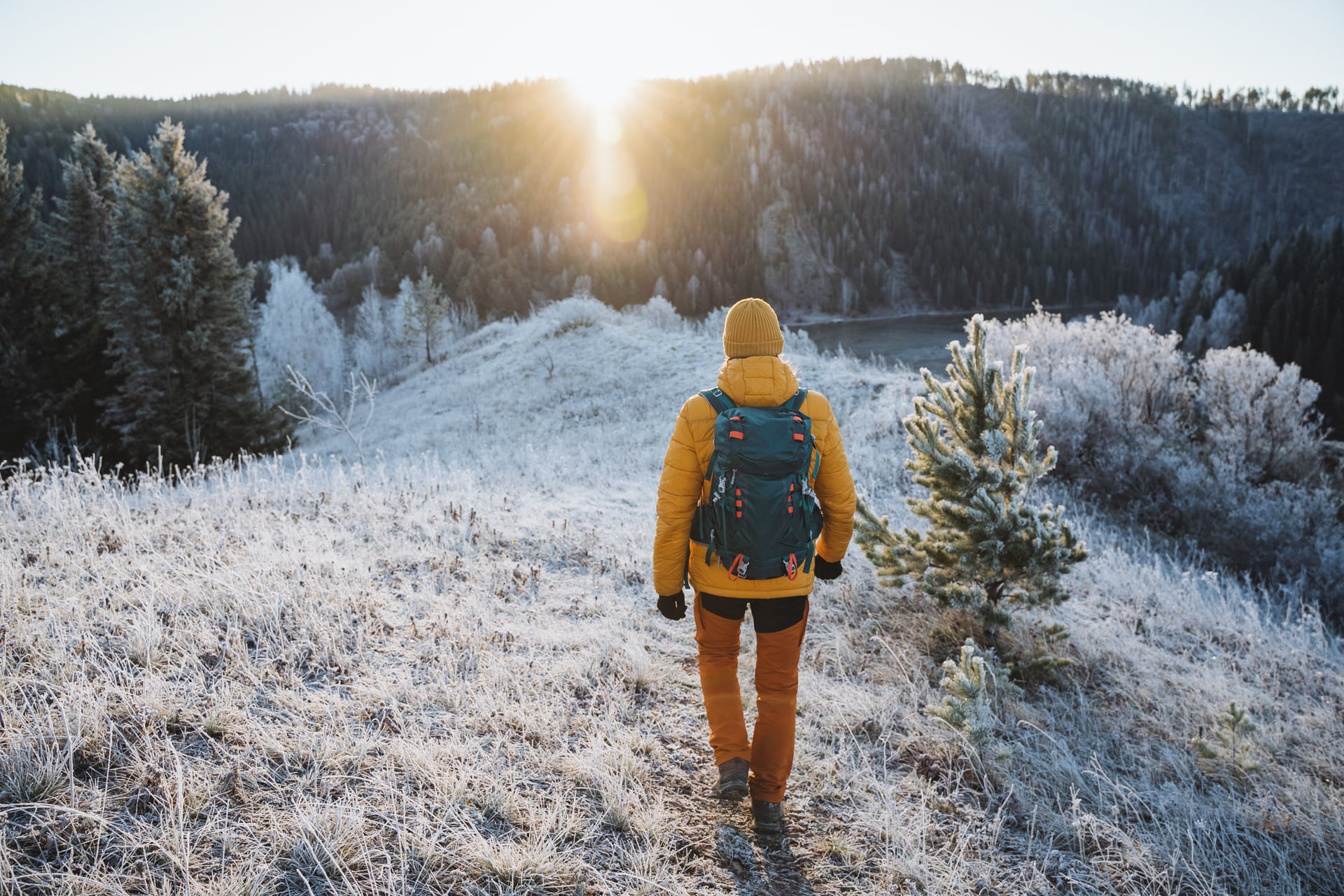
Winter transforms Ordesa into serious mountaineering terrain. Snow begins around 1,600 m and lasts through spring, making many routes technical and requiring winter equipment and experience.
Temperatures: Valleys generally range from 0–10°C, while higher elevations often stay below freezing throughout the day.
Best for: Experienced winter mountaineers only — not suitable for casual hikers.
Good to know:
Snow and ice persist well into late spring
High routes require crampons, ice axe, and winter skills
Limited access and rapidly changing weather
Valley trails may still be icy
What to Do in Bad Weather
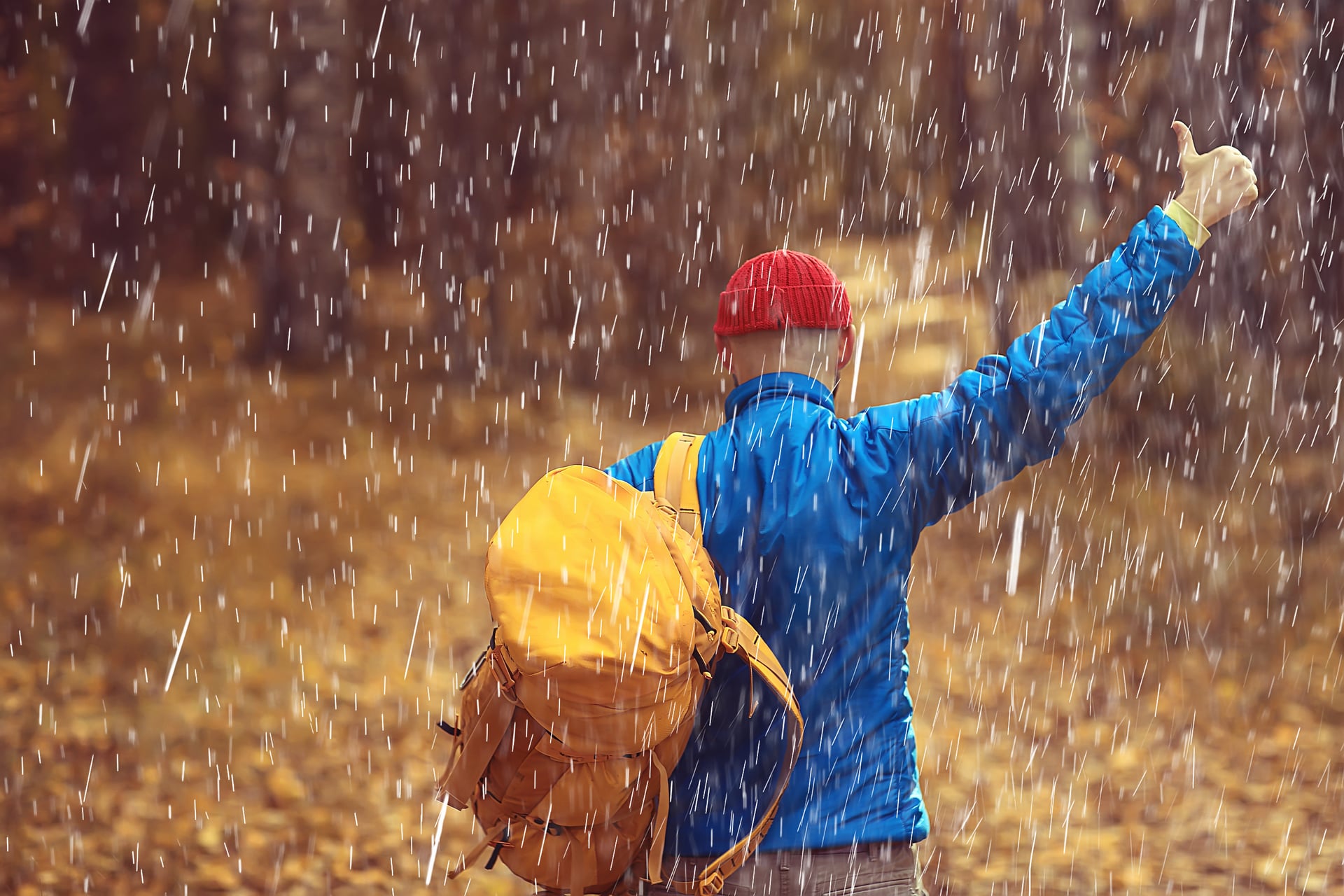
The Pyrenees are notorious for sudden weather changes. A clear morning can turn into heavy rain or thunderstorms by early afternoon, particularly in July and August. If you hear thunder or see dark clouds building, descend immediately or take shelter, exposed ridges and high passes are extremely dangerous during storms.
Many refuges and gîtes have common rooms where you can wait out bad weather, read, play cards, or chat with other hikers. Torla has several cozy cafés and restaurants perfect for rainy day rest.
Where to Check the Weather
Weather in Ordesa can change quickly due to its mix of deep valleys and high-altitude terrain. Conditions often differ between the valley floors, mid-mountain routes and exposed high passes, so checking a reliable forecast is essential before choosing a trail or planning a full-day hike.
Best sources:
AEMET — Spain’s official forecast; the most reliable for Torla, Broto and valley-level conditions
Windy — Great for visualising wind, storms and temperature changes on high routes
Yr.no — Clean, reliable forecasts that perform well in mountainous regions
Best Hikes in Ordesa y Monte Perdido National Park
Ordesa y Monte Perdido National Park is home to some of the most dramatic landscapes in the Pyrenees, and its network of trails offers something for every type of hiker.
From balcony-like cliff paths to lush canyon routes and high-altitude ascents, the park’s hikes showcase its astonishing variety.
Below are the best routes to help you plan an unforgettable day in Ordesa.
1. Cola de Caballo (Classic Ordesa Valley)
This is the park’s most iconic hike, starting from the Pradera de Ordesa at 1,300 metres and following the Arazas River through cliffs, waterfalls and mixed beech–fir–pine forest. The well-maintained path is mostly flat for the first 6 kilometres, making it ideal for families and casual hikers, before the valley narrows and the scenery grows more dramatic.
📏 Distance: 17–18 km (round trip)
⏱️ Time: 5–6 hours
⛰️ Elevation: +500 m
⚖️ Difficulty: Moderate
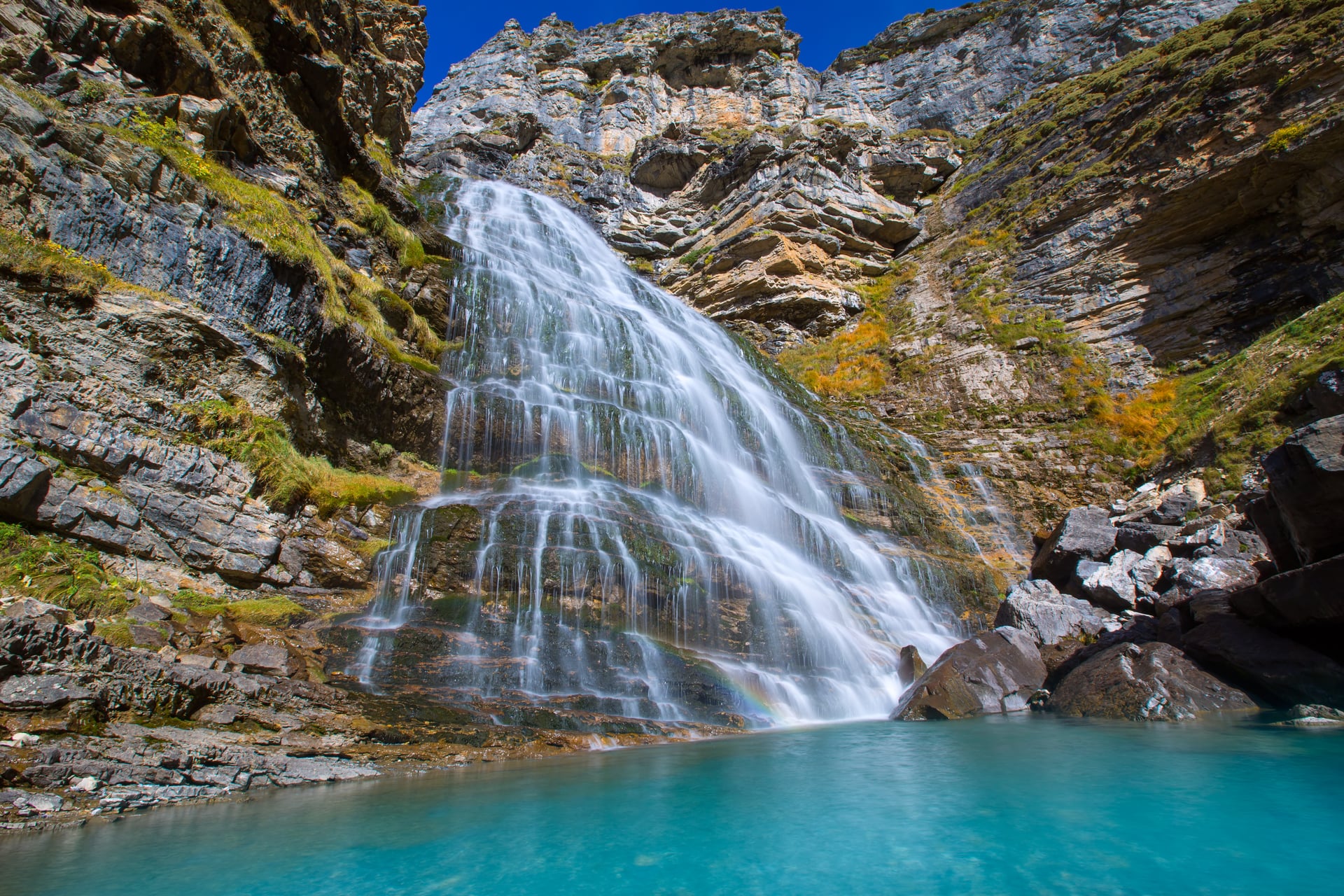
After around 8.5 kilometres you reach the Circo de Soaso, a spectacular glacial amphitheatre, and at its far end the Cola de Caballo waterfall, a wide, graceful cascade that marks the natural turnaround point for most hikers.
2. Senda de los Cazadores + Faja de Pelay Loop
This legendary balcony route is one of the most thrilling hikes in the Pyrenees, combining a steep 900-metre ascent, exposed ledges and sweeping views over the entire Ordesa Valley. The climb up the Senda de los Cazadores is relentless but rewards you with ever-expanding panoramas until you reach the Mirador de Calcilarruego, one of Spain’s finest viewpoints.
📏 Distance: 21 km
⏱️ Time: 6–8 hours
⛰️ Elevation: +900 m
⚖️ Difficulty: Hard
3. Añisclo Canyon
It’s cooler than Ordesa, making it ideal on hot days, and the constant sound of the river adds to the experience. Añisclo is also far quieter, so even in peak season you can walk long stretches in solitude. It’s one of the best options for hikers seeking a more enclosed, peaceful valley.
📏 Distance: 13–16 km (varies by route)
⏱️ Time: 4–6 hours
⛰️ Elevation: +350 m
⚖️ Difficulty: Moderate
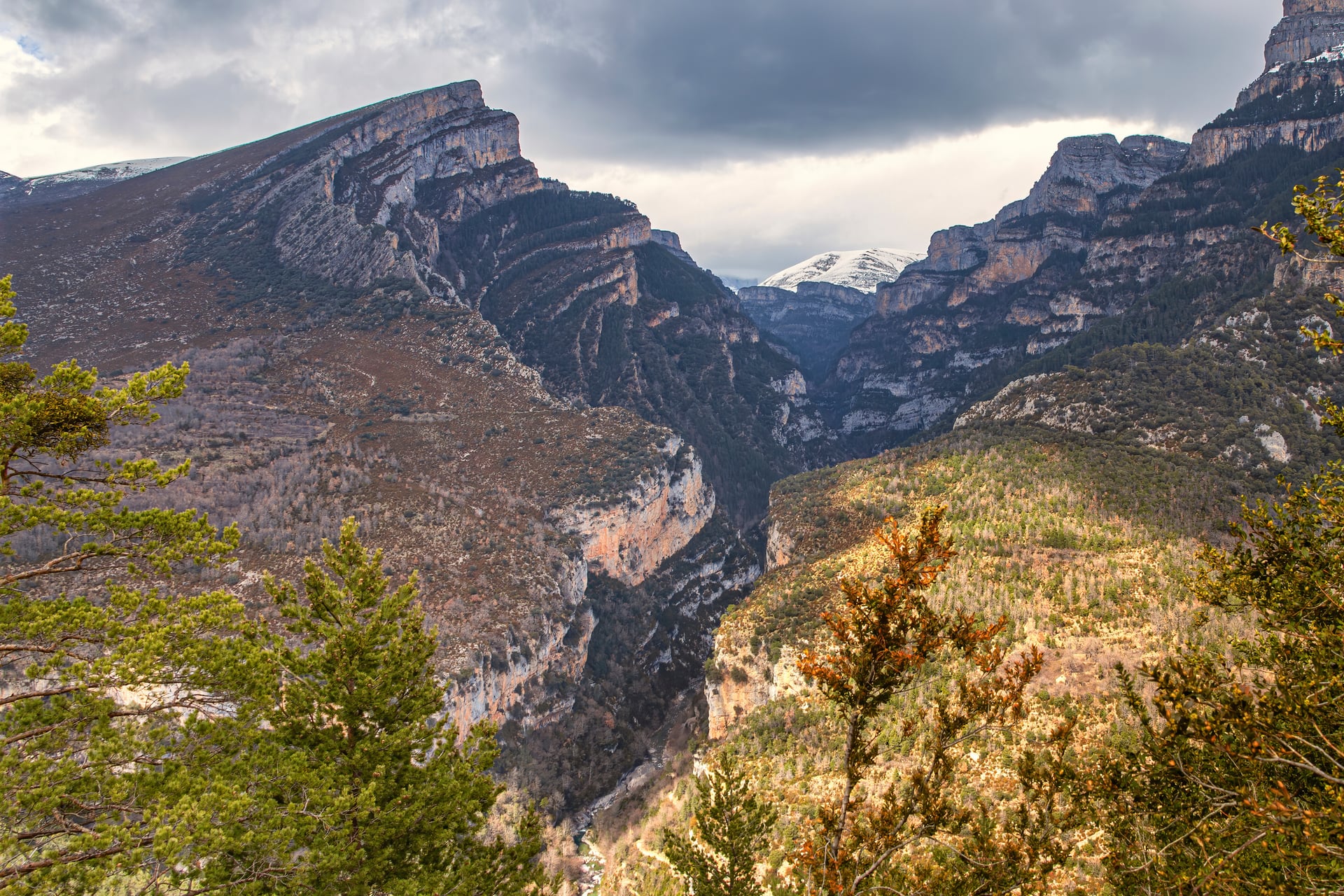
The Añisclo Canyon offers a very different feel from the wide-open views of Ordesa. The trail follows the Bellós River through a deep, narrow limestone gorge, with steep rock walls that often block out the sun.
4. Balcón de Pineta
This is one of the park’s most strenuous day hikes, climbing over 1,200 metres in just 6 kilometres from the Pineta Valley to the Balcón de Pineta. The ascent is steep and continuous, but the payoff is exceptional. From the balcony, you get a sweeping view of the Monte Perdido massif, with waterfalls dropping nearly 1,000 metres from the cliffs above.
📏 Distance: 12 km (round trip)
⏱️ Time: 6–7 hours
⛰️ Elevation: +1,200 m
⚖️ Difficulty: Hard
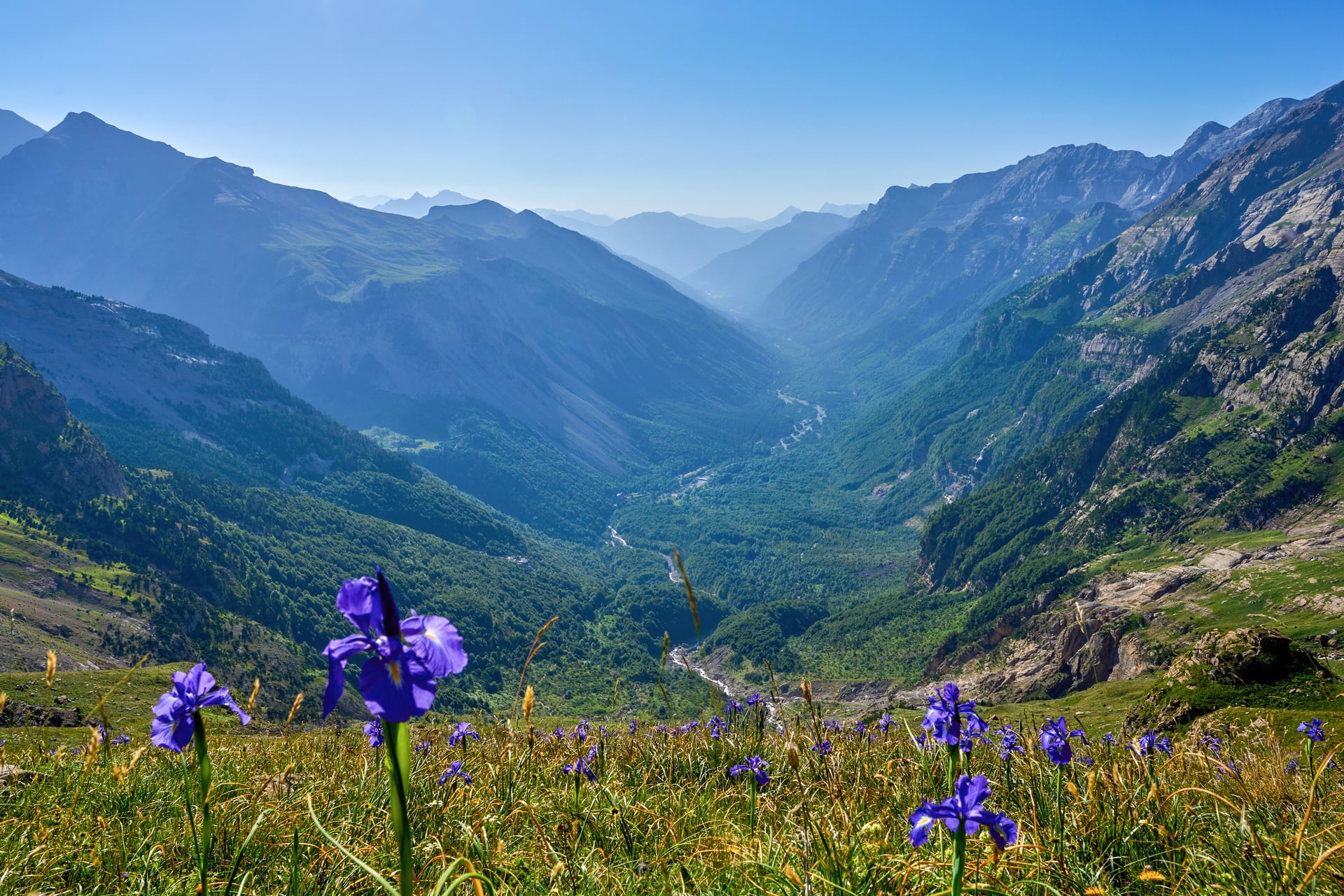
The Pineta Valley is quieter than Ordesa, and this route sees relatively few hikers despite its dramatic scenery. It’s a demanding hike best suited to strong hikers who enjoy big climbs and high, exposed viewpoints.
5. Monte Perdido Summit
Climbing Monte Perdido (3,355 m) is a demanding alpine route suited only to experienced hikers. Most start from the Refugio de Góriz for an early approach. The ascent crosses rocky ground, scree and often snow, with the final Escupidera section steep, exposed and sometimes requiring crampons. Weather changes fast, making the route hazardous in poor conditions.
📏 Distance: 15 km (round trip from Góriz)
⏱️ Time: 8–10 hours
⛰️ Elevation: +1,150 m
⚖️ Difficulty: Very Hard
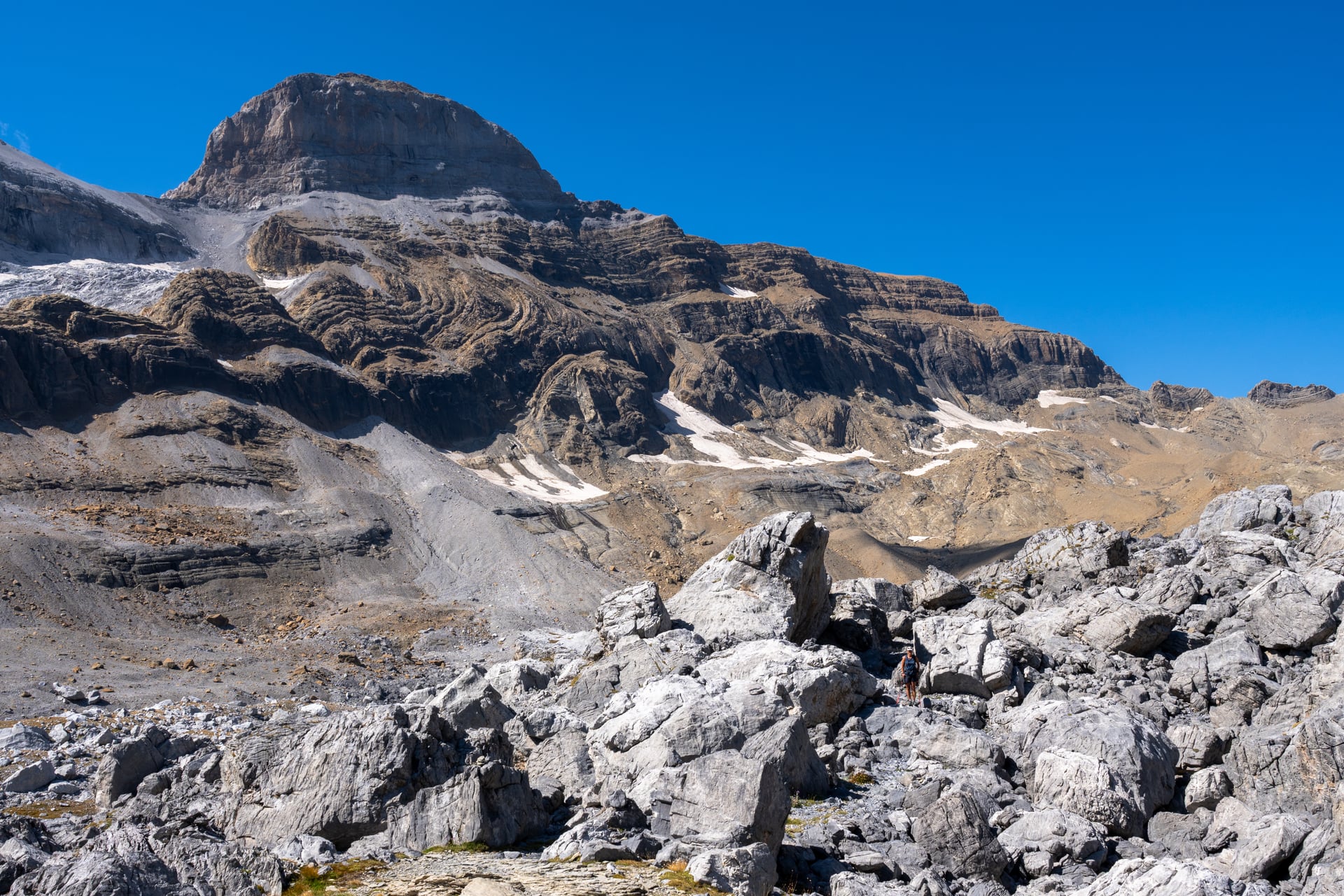
The summit offers one of the Pyrenees’ best panoramas, but solid fitness, mountain skills and good judgement are essential. Many climbers spend a night or two at Góriz to time their ascent.
How Much Time Do You Need in Ordesa
You can visit Ordesa in a day, but two to four nights gives you enough time to explore multiple valleys and tackle one of the classic balcony trails. If you’re aiming for Monte Perdido or high routes, plan on five to seven days.
And if you want a ready-made itinerary, our self-guided or guided tours cover the region’s best hikes without any planning stress.
Where to Stay in Ordesa
Ordesa offers a good range of accommodation options, from village guesthouses to high-altitude refuges. Most hikers base themselves in Torla-Ordesa, which has the best selection of hotels, small inns, apartments and mountain lodges. Torla offers more than 1,000 beds across all accommodation types, making it the most convenient place to stay if you plan to explore the Ordesa Valley.
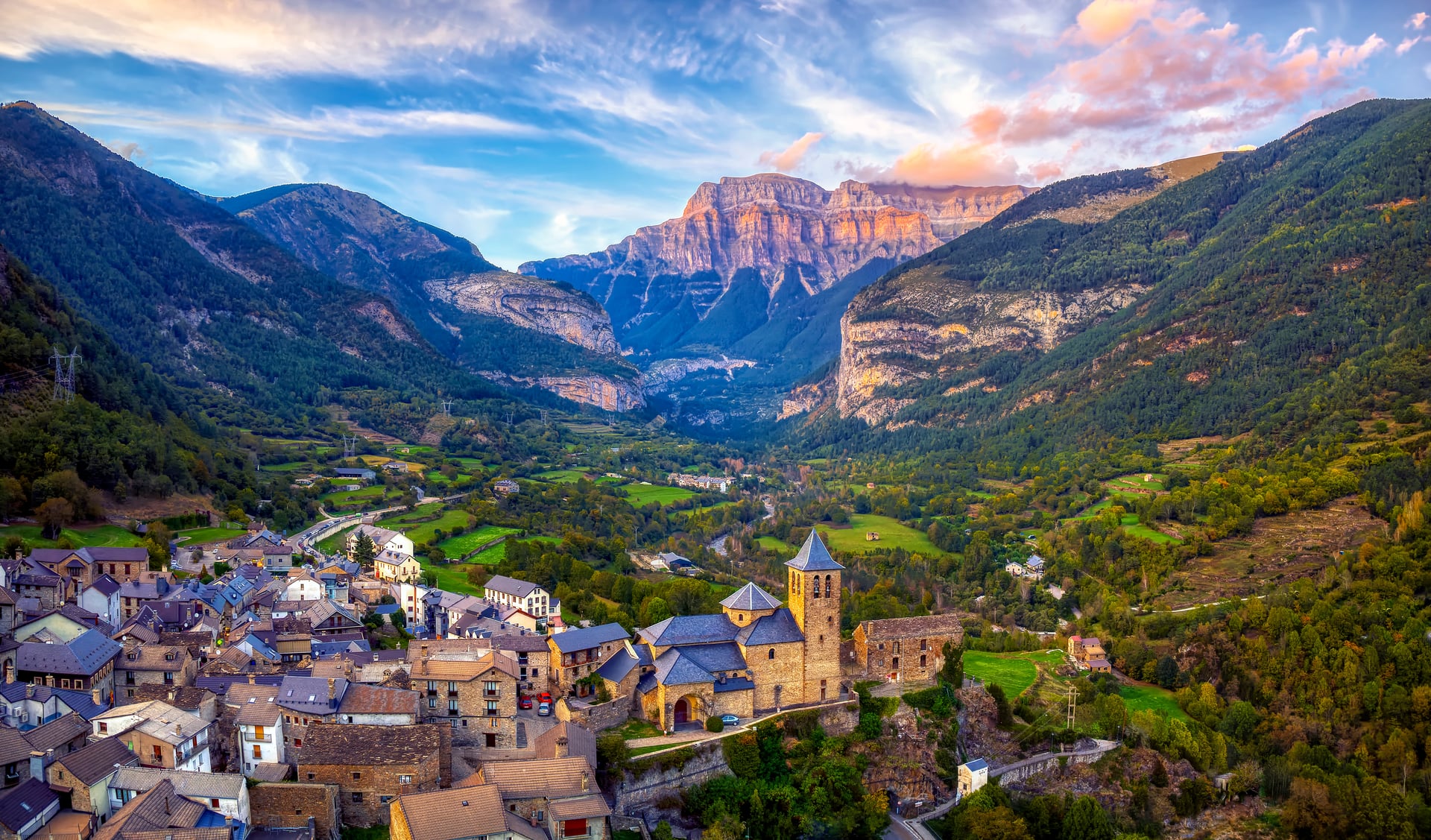
The village has everything you need: supermarkets, bakeries, restaurants, gear shops and easy access to the park shuttle buses. Staying in Torla means you can walk out of your door, catch the shuttle to the trailhead, and be hiking within 30 minutes. Evenings in Torla feel lively during summer, with hikers gathering in the village square to share stories over local wine and regional dishes.
For those planning to explore the other valleys, Broto (10 km from Torla) and Bielsa (gateway to Pineta) are excellent alternatives. These villages are quieter and give you direct access to the less-visited parts of the park.
High-Altitude Refuge: Refugio de Góriz
The Refugio de Góriz sits at 2,200 metres in the heart of the park and is essential for anyone planning multi-day high routes or attempting Monte Perdido. The refuge offers roughly 96 sleeping places in shared dormitories, hot meals, basic washing facilities and stunning sunrise views over the surrounding peaks.
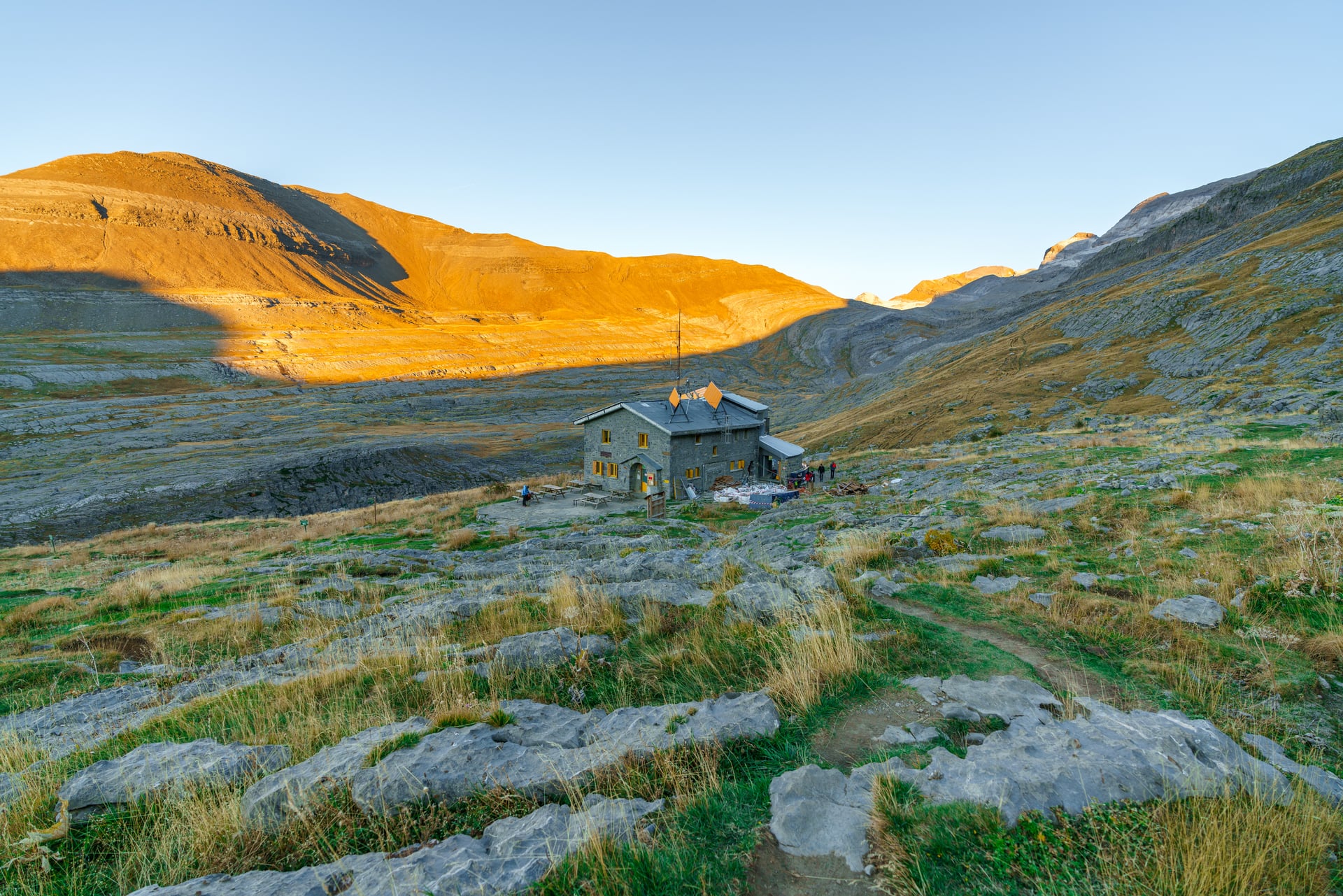
Góriz is the main staging point for the ascent of Monte Perdido, the Cilindro de Marboré, and several other high alpine routes. During summer, it is extremely popular and reservations must be made weeks in advance. The refuge operates from approximately mid-June to late September, depending on snow conditions.
You can make a booking for Refugio de Góriz through the official website of the Federación Aragonesa de Montañismo.
Is Camping Allowed in Ordesa?
Camping inside the main valleys of the park, Ordesa, Añisclo and Escuaín is not permitted due to strict conservation regulations designed to protect the park's fragile ecosystems. However, bivouacking (a simple overnight stay with a lightweight tent) is allowed above 2,100 metres and only for one night, between sunset and sunrise.
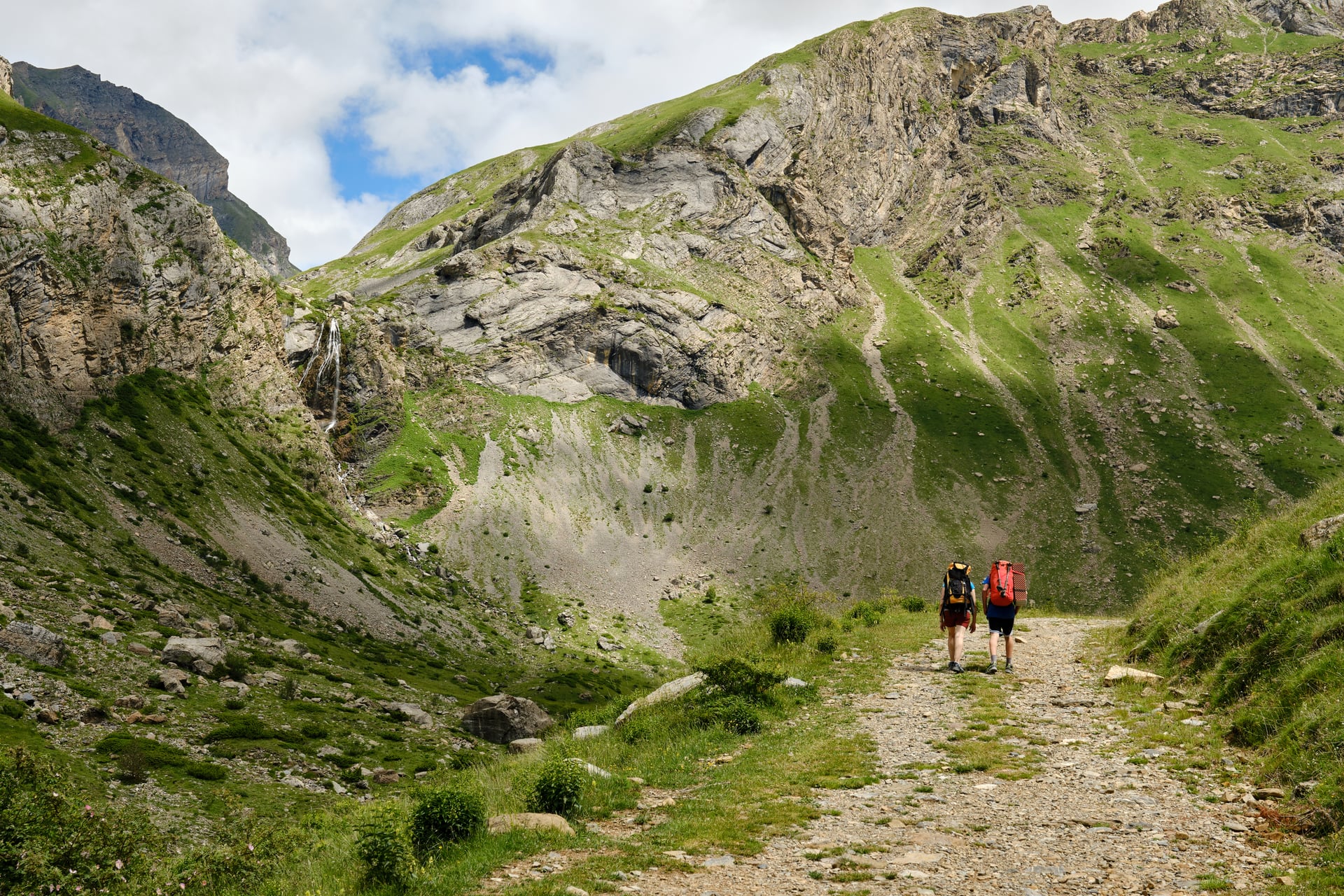
This rule makes bivouacking suitable primarily for those linking multi-day high routes, such as the traverse from Góriz to Pineta or climbs of Monte Perdido. You must pitch after dark and break camp before dawn, leaving no trace of your stay.
For those wishing to camp closer to the valley floors, several excellent designated campsites operate just outside the park boundaries near Torla and Broto. These campsites offer grass pitches, hot showers, laundry facilities and small shops, making them a comfortable base for exploring the park while enjoying the outdoor experience.
How to Get Around Ordesa
Getting into Ordesa can involve either driving directly to the valley or using the seasonal shuttle service, depending on the time of year. Access rules change between summer, weekends, and peak holiday periods, which can make the system feel confusing for first-time visitors.
Understanding the parking options and transport setup in advance will help you choose the best way to reach the trailhead without surprises.
Summer Shuttle Bus System (Mid-June to Late September)
During the peak season, typically from mid-June to late September, private vehicles are prohibited from driving up the road to the Pradera de Ordesa trailhead. This restriction is in place to protect the park's environment and manage the high volume of visitors.
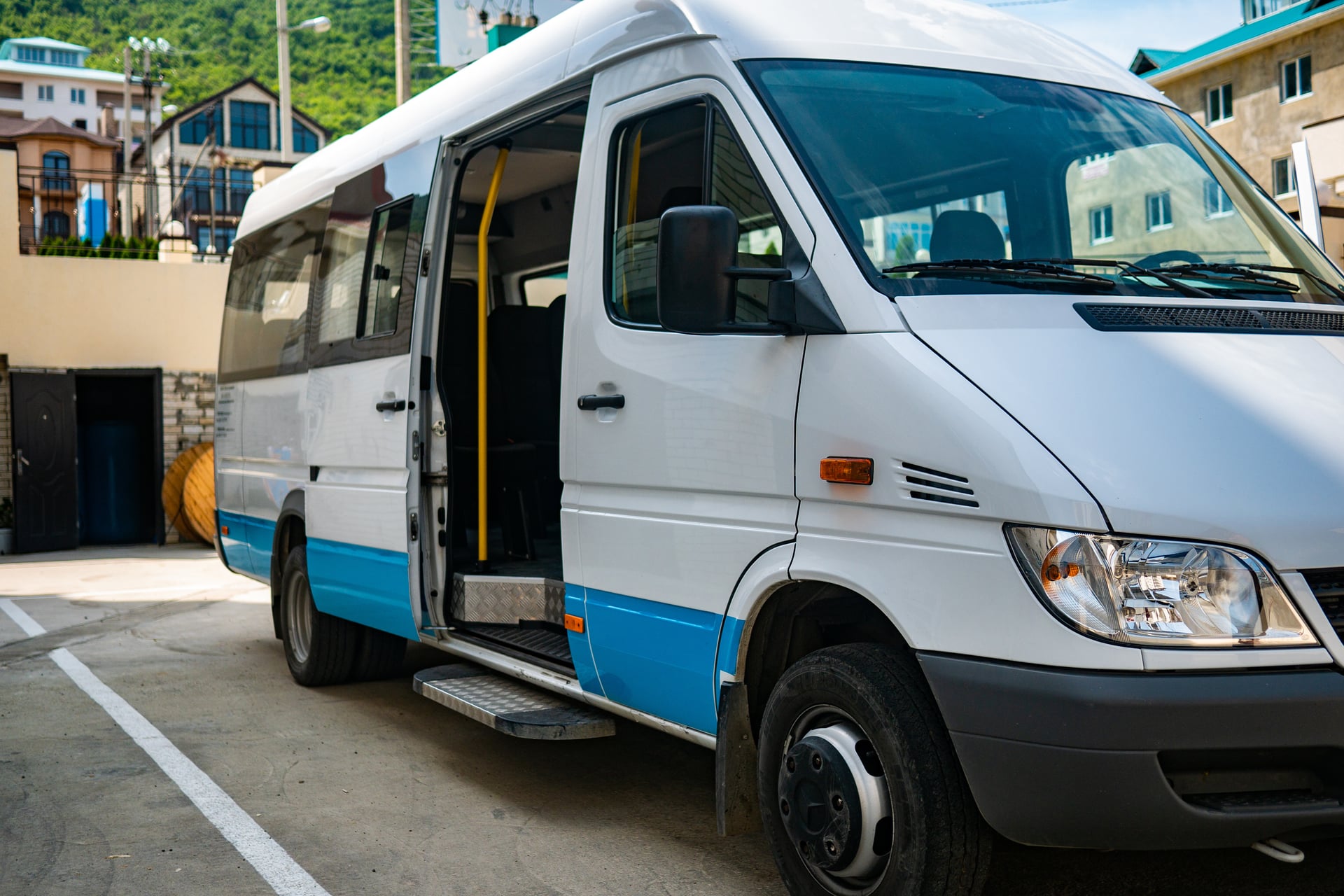
Instead, all visitors must park in Torla's large designated parking area and board official shuttle buses that run throughout the day. The shuttles depart every 15–20 minutes from approximately 6:00 AM to 8:00 PM, depending on demand. The journey from Torla to the Pradera de Ordesa takes roughly 12 minutes.
The shuttle service is efficient, inexpensive, and allows you to relax before your hike without worrying about parking at the trailhead. You can check current timetables and fares on the park's official website before your visit.
Off-Season Parking (October to May)
Outside the main summer season, the road to Pradera de Ordesa sometimes reopens to private vehicles, allowing you to drive directly to the trailhead. However, this depends on snow, ice and road conditions, and closures can occur at short notice. Always check for updated information before assuming you can drive all the way.
Parking in Other Valleys
Parking in the Añisclo, Pineta and Escuaín sectors is more relaxed year-round. Small car parks are available near the main trailheads, but these lots are limited and often fill by mid-morning on weekends and holidays. Arriving early, before 9:00 AM remains the best strategy throughout the park, regardless of the season.
Essential Packing List for Ordesa
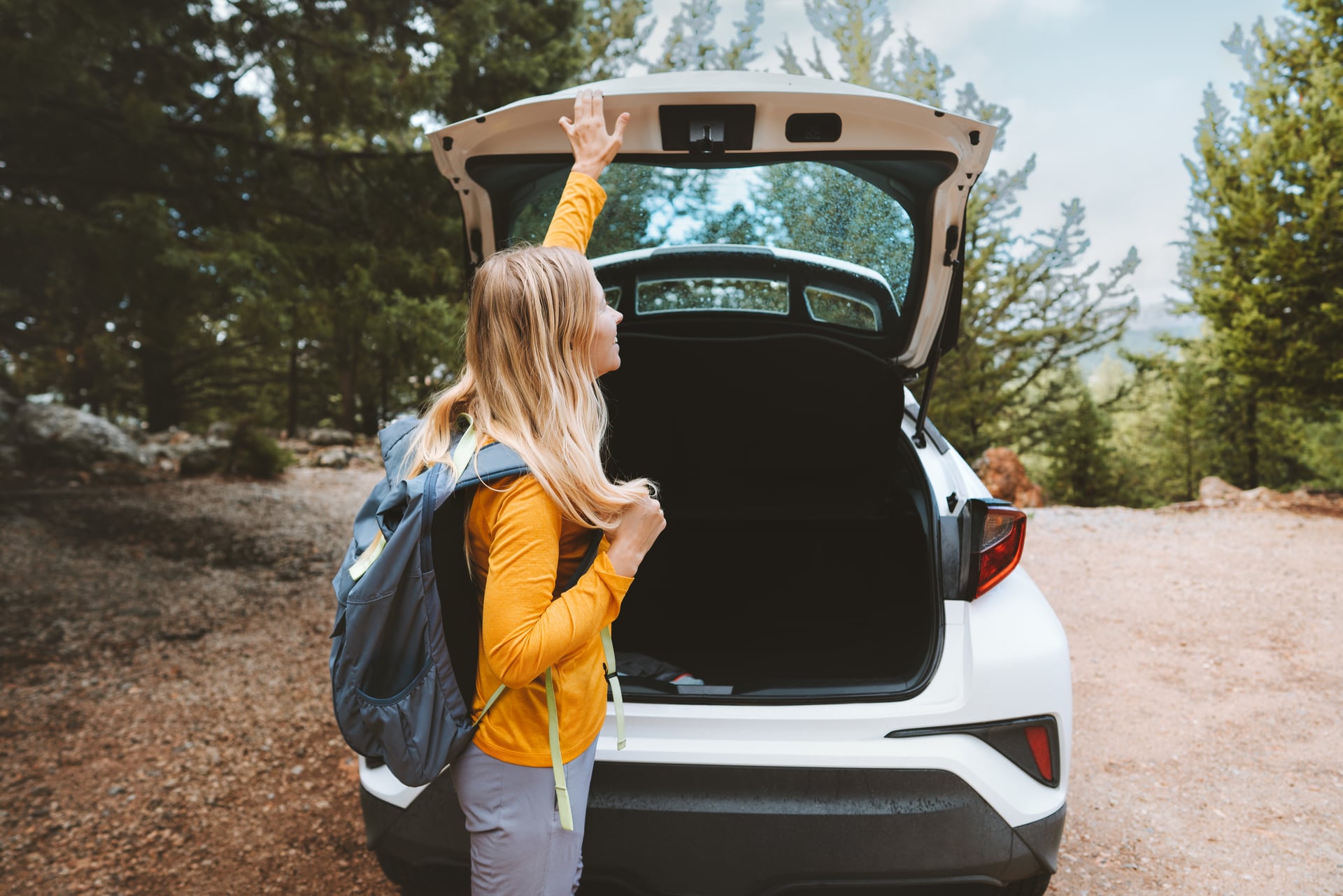
What you need to bring for Ordesa changes with the weather. Hot, dry trails in summer call for different items than the cooler, wetter conditions you’ll find in spring or fall. This essential packing list will help you cover the basics.
If you choose to hike with us, you’ll get a detailed, personalised packing guide tailored to your route, dates and comfort level — making your planning much easier.
Passport or National ID (valid for travel within the EU)
Hiking boots – broken in, waterproof and with good ankle support
Trekking poles – highly recommended for steep descents and long days
Backpack (25-35L for day hikes, 50-60L if staying at refuges)
Hiking clothes: moisture-wicking base layers, hiking pants or shorts, long-sleeve shirt for sun protection
Fleece or insulated jacket – temperatures drop quickly at altitude
Waterproof jacket and pants – afternoon storms are common in the Pyrenees
Hat and sun protection – sunglasses, sunscreen (SPF 30+), lip balm with SPF
Warm layers for high-altitude routes – even in summer, passes above 2,000m can be cold
Casual clothes for evenings in villages
Lightweight sandals or camp shoes for relaxing after hiking
Reusable water bottle or hydration system (2-3L capacity)
Headlamp or flashlight with extra batteries
First aid kit – including blister treatment, pain relievers, bandages, and any personal medications
Phone + charger + EU plug adapter (Type C or F for Spain)
Power bank to keep devices charged on long days
Maps and guidebook – printed or downloaded offline (mobile reception can be limited)
Credit/debit cards and euros in cash – small villages and refuges may not accept cards
Local SIM card (optional) – available in Spanish cities for better connectivity
Practical Tips for Your Ordesa Trek
Currency and Payments
Spain uses the Euro (€) as its official currency.
ATMs are available in larger towns near the park such as Torla, Broto, Bielsa. Most hotels, restaurants and shops accept credit and debit cards, but it's wise to carry some cash, especially when visiting mountain refuges or small family-run guesthouses where card machines may not be available.
Tipping in Spain is customary but not obligatory. Rounding up the bill or adding 5–10% for excellent service is appreciated in restaurants and bars, though not expected.
Emergency Numbers and Safety
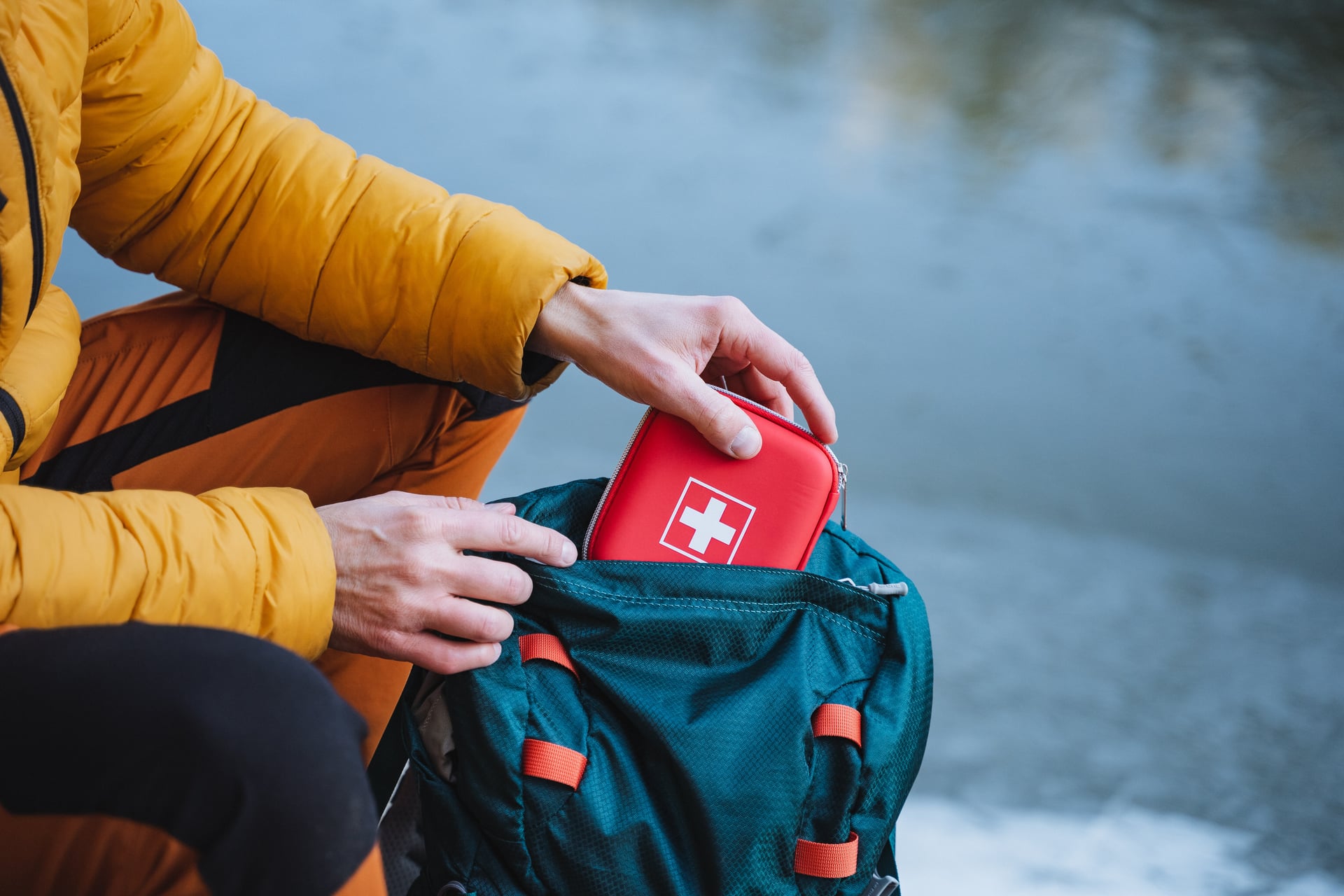
Spain is generally a very safe place to hike, but Ordesa’s remote valleys and high-altitude terrain require proper preparation. Mobile reception can be unreliable in deep valleys and cirques, so it’s essential to hike with caution and let someone know your planned route.
Key emergency contacts:
112 — General emergency number (police, ambulance, fire, Mountain Rescue / GREIM)
Works from any phone, with or without signal in many cases
Safety tips:
Always check the weather forecast before starting your hike
Carry extra layers, food, water and a fully charged phone
Turn back immediately if conditions worsen — storms develop fast
Share your route and expected return time with someone
Local assistance:
The Torla Visitor Centre (Centro de Visitantes de Torla–Ordesa) provides up-to-date trail info, weather conditions and safety guidance
Staff can advise on route closures, shuttle schedules and current conditions in the park
Useful Spanish Phrases for the Trail
Here are 20 useful Spanish phrases that will help you during your time in Ordesa:
Hola (OH-lah) – Hello
Buenos días (BWEH-nos DEE-ahs) – Good morning
Buenas tardes (BWEH-nas TAR-des) – Good afternoon
Buenas noches (BWEH-nas NO-ches) – Good evening / Good night
Adiós (ah-dee-OHS) – Goodbye
Gracias (GRAH-thee-ahs) – Thank you
Por favor (por fah-VOR) – Please
Sí / No (see / noh) – Yes / No
Perdón / Disculpe (per-DOHN / dees-COOL-peh) – Excuse me / Sorry
¿Habla inglés? (AH-blah een-GLAYS) – Do you speak English?
No entiendo (noh en-tee-EN-doh) – I don't understand
¿Cuánto cuesta? (KWAN-toh KWES-tah) – How much does it cost?
¿Dónde está…? (DOHN-deh es-TAH) – Where is…?
Agua (AH-gwah) – Water
El refugio (el reh-FOO-hee-oh) – The mountain hut
La farmacia (lah far-MAH-thee-ah) – The pharmacy
El sendero (el sen-DEH-roh) – The trail / path
Estoy cansado/a (es-TOY kan-SAH-doh/dah) – I am tired
Una cerveza, por favor (OO-nah ther-VEH-thah por fah-VOR) – A beer, please
¡Buen camino! (bwen kah-MEE-noh) – Have a good hike!
Health and Altitude Considerations
Most trails in Ordesa stay below 2,500 metres, so altitude sickness is rarely a concern for day hikers. However, if you're planning to climb Monte Perdido or spend nights at Refugio de Góriz (2,200m), it's wise to acclimatize gradually. Drink plenty of water, pace yourself on steep ascents, and listen to your body.
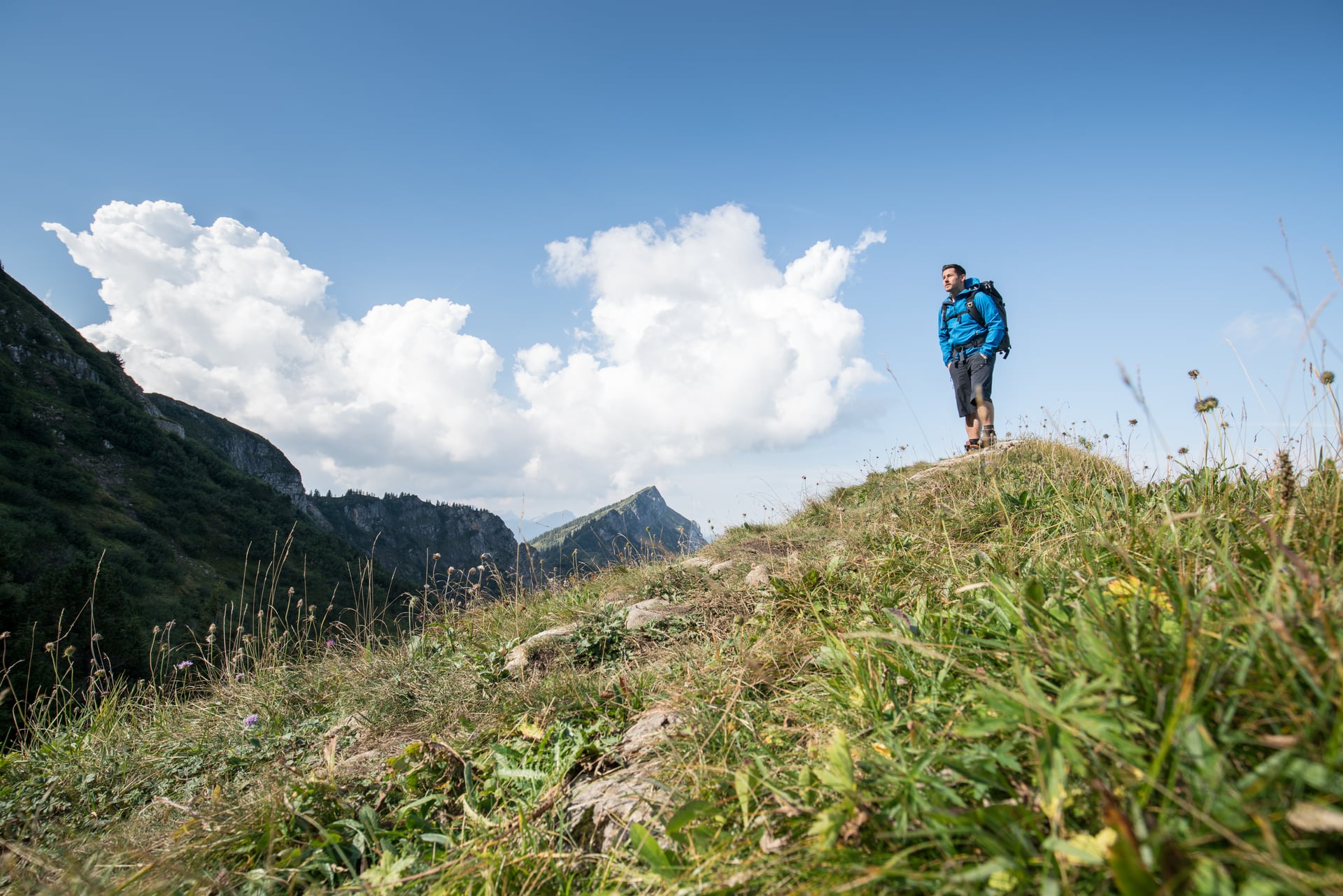
Sunburn is a real risk at altitude, even on cloudy days. UV radiation increases with elevation, so apply sunscreen regularly and wear a hat.
Respect the Park
Ordesa y Monte Perdido is a protected national park with strict conservation rules. Please follow these guidelines to help preserve the landscape for future generations:
Stay on marked trails, shortcuts cause erosion
Carry out all rubbish, including organic waste like fruit peels
Do not pick flowers or disturb wildlife
Keep noise levels low, especially near refuges and in quiet valleys
Do not feed animals, particularly the semi-wild horses and marmots
Camp only in designated areas or above 2,100m for bivouacking
Use toilets at refuges and trailheads; if nature calls on the trail, bury waste at least 50m from water sources
How to Get to Ordesa y Monte Perdido National Park
The Gateway: Torla-Ordesa
Almost all visitors begin their journey in Torla-Ordesa, the charming stone village that sits just 2 kilometres from the main park entrance at an elevation of 1,033 metres. Torla serves as the primary base for exploring the Ordesa Valley and offers the best combination of accommodation, restaurants, shops and transport connections.
By Air
Spain has several international airports that provide convenient access to the Pyrenees and Ordesa National Park.
Zaragoza Airport (ZAZ) – The closest major airport to Ordesa, located about 150 km away. Limited international flights but excellent for connections from other Spanish cities.
Toulouse-Blagnac Airport (TLS) – In southern France, roughly 220 km from Torla. Offers more international connections and is a good alternative for travelers coming from Europe.
Barcelona-El Prat Airport (BCN) – Spain's second-largest airport, about 330 km from Ordesa. Excellent international connections and direct motorway access to the Pyrenees.
Bilbao Airport (BIO) – In the Basque Country, approximately 280 km away. Good for travelers combining coastal and mountain experiences.
Pamplona Airport (PNA) – A smaller regional airport about 130 km from Torla, useful for domestic connections.
Many travelers spend a night in Zaragoza, Huesca, or Jaca before or after their trek to break up the journey and explore the region's historic towns.

By Public Transport
Public transport to Torla is limited and seasonal, typically operating from June through September. The most reliable route involves taking a train to Zaragoza or Huesca, then connecting to a bus service that runs to Sabiñánigo or Broto, followed by a local shuttle to Torla. This journey can take 3–5 hours from Zaragoza depending on connections.
Access to the valley itself is via the Torla–Ordesa shuttle, managed by the local transport provider Autocares Escartín.
During summer months, a dedicated bus service sometimes runs directly from Zaragoza to Torla, making the journey significantly easier. It's advisable to check current schedules well in advance of your trip, as services change each season.
By Car
From Zaragoza: 1 hour 45 minutes via A-23 and N-260
From Pamplona: 2 hours via N-240 and N-260
From Barcelona: 3.5–4 hours via A-2, A-22 and N-260
From Huesca: 1 hour 15 minutes via N-260
Accessing Other Valleys in the Park
While Torla serves the Ordesa Valley, the park's other valleys require different access points:
Añisclo Canyon: Accessed via the village of Escalona or the small hamlet of La Ripareta
Pineta Valley: Reached through the village of Bielsa on the northern side of the park
Escuaín Valley: The most remote, accessed via the tiny village of Escuaín on narrow mountain roads
Each valley offers distinct landscapes and quieter trails compared to the busier Ordesa sector.
Plan Your Ordesa Hiking Adventure
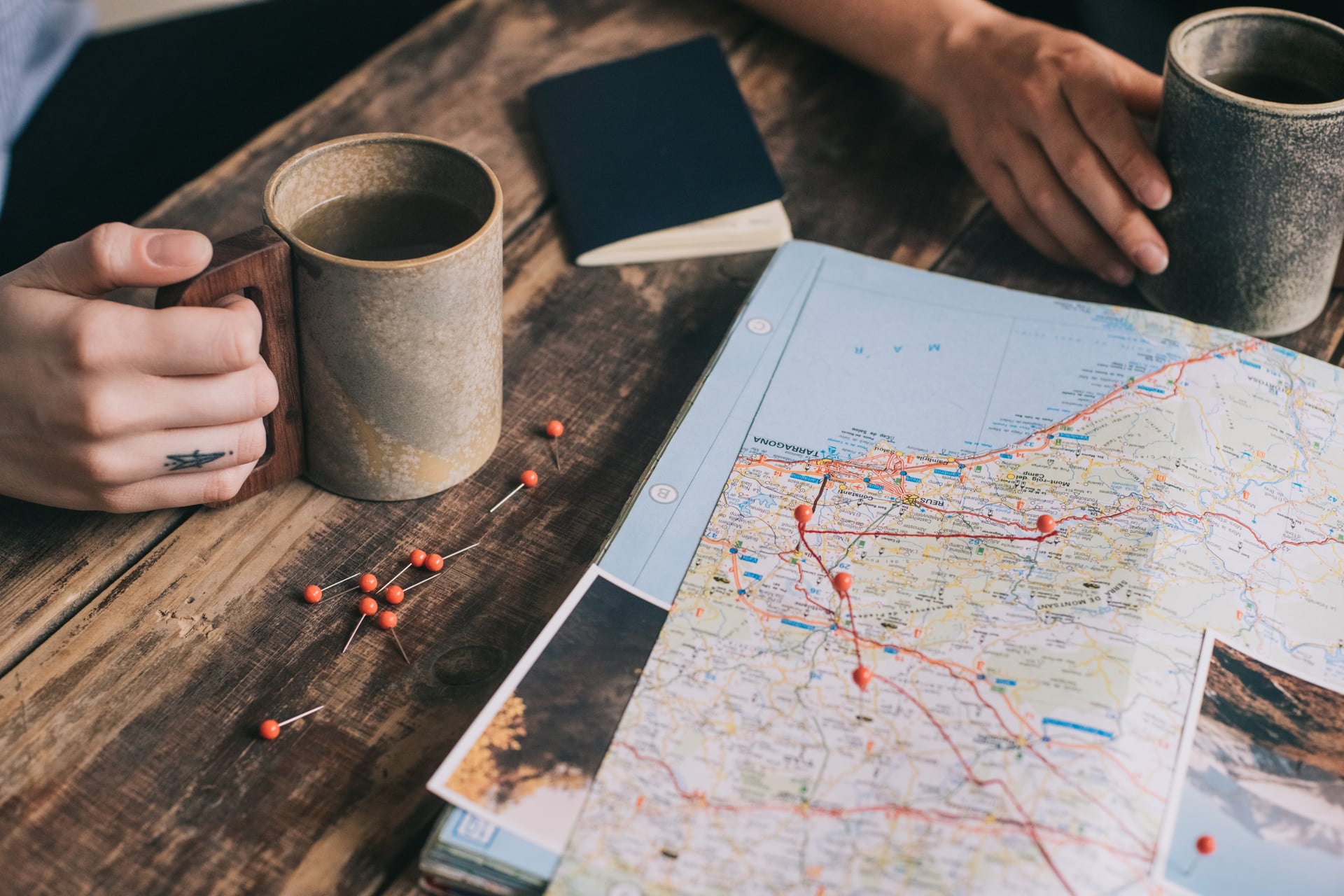
Planning a hiking trip in Ordesa involves managing refuge bookings, route variations and fast-changing mountain conditions, tasks that can quickly become overwhelming, especially in peak season.
If you’d rather skip the logistics and focus on enjoying the scenery, consider one of our supported hiking trips:
We can help you plan a tailored itinerary that covers Ordesa’s best trails without any logistical stress.
Send us your dates, and we’ll create a personalised hiking plan for Ordesa y Monte Perdido.



Plan with a hiking expert
Free advice from a team that knows these routes inside out - real people, not a bot

HASSLE-FREE
We handle itineraries, accommodations, and anything else you prefer not to deal with, so you can enjoy a carefree hike.

BOOK WITH CONFIDENCE
We are a financially protected company, fully bonded and insured, keeping your money safe and allowing you to travel with confidence.

TRIED & TESTED ADVENTURES
Only the best hut to hut hikes in Europe, cherry-picked by our local team with an in-depth knowledge of the region.

UNBEATABLE SUPPORT
Our 24/7 customer support is where we show our passion, bringing you a better experience by making your well-being our number one priority.